How Kerr County and the Upper Guadalupe River Authority Responded to Disaster in Record Time
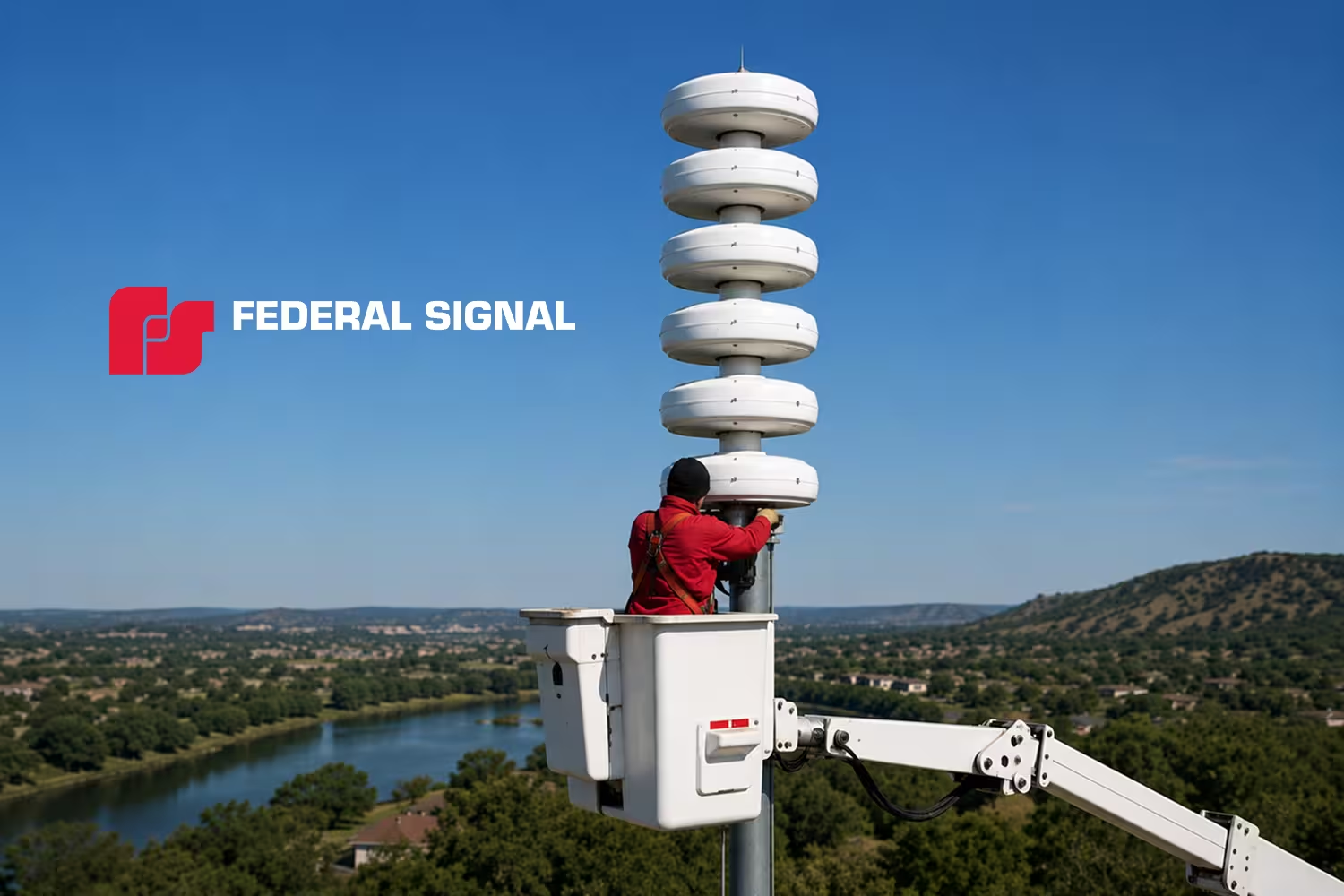
Table of contents
On the Fourth of July 2025, a devastating flash flood tore through the Upper Guadalupe River Valley in central Texas. Within 45 minutes, the river had risen 26 feet. More than 130 people lost their lives as a result, including 25 young girls and two camp counsellors at Camp Mystic. To date, two people remain missing.
In response to this tragedy, the Kerrville local community, Texas state government, and federal government all expected a quick and impactful response to ensure that this disaster would not happen again. Kerr County needed a comprehensive flood warning system.
Results & Impact
Key Outcomes
- The Upper Guadalupe River Authority (UGRA) accessed a pre-qualified vendor at pre-negotiated pricing.
- The contract satisfied the strict compliance requirements attached to state emergency funding, while moving at the pace the community demanded.
- Kerr County became the first county in Texas to install Senate Bill 3-mandated flash flood warning sirens.
- With Phase 1 complete and the procurement mechanism proven, UGRA is positioned to expand the siren network toward its full 30-unit target.
The Challenge
Kerr County, the City of Kerrville, the Upper Guadalupe River Authority, community groups, state legislators, engineers, and grant administrators all came together in the months that followed the flooding. They were driven by a shared desire to quickly implement a flash-flood outdoor warning system to ensure communities had more time to anticipate and react to future floods.
"The disaster is really the common ground. It's what caused us to put on one jersey and say ‘We've got a problem. How are we going to fix it?’" explained William Whitson, Long Term Recovery Senior Consultant, Kerr Together.
The Texas Legislature, having mandated outdoor warning sirens through Senate Bill 3 and allocated emergency funding, attached strict procurement compliance requirements to that money. And the public — the camps, the community, the parents — needed visible, credible reassurance before summer 2026 arrived.
"There can be a lot of temptation to cut corners in procurement compliance," Whitson said. "But if you're spending public money, you've got to get the procurement right. You have to cross your t’s, dot your i’s, and make sure everything is transparent."
The Solution
UGRA solicited proposals from five vendors through two cooperative purchasing agreements, and of the four compliant responses that came back, Federal Signal’s OmniWarn system under the TXShare Public Hazard Alerting System contract emerged as the clear best fit.
Crucially, the cooperative contract had been procured under 2 CFR 200 Uniform Guidance – the strict federal standard required for spending state and federal emergency grant funding – meaning UGRA could move fast without any compliance risk to the Senate Bill 3 grant money.
Jonathan Letz, a member of the UGRA Board of Directors, explained in a public meeting that the project then continued to progress at an impressive pace: “What has been accomplished is really phenomenal when you consider that this is a public entity. March 19, we purchased the sirens. That’s within six weeks after we got the guidance document. By May 11, we had the first six sirens installed.”
"It just so happened that Federal Signal met all of the criteria that was outlined in the statutes,” explains Whitson. “The design of its system means it is an outdoor flood warning siren that could also be a tornado warning and a wildfire warning. It was a readily available product that had been secured in advance."
Implementation & Investment
UGRA's board voted 6-0 to ratify a $716,817.90 purchase order with Federal Signal, covering equipment, software, installation, integration, and shipping for an eight-siren initial phase. UGRA fronted the capital themselves, a decisive move by UGRA General Manager Tara Bushnoe and her board, while awaiting reimbursement from the state – a circa $1.25 million grant under the Senate Bill 3 Outdoor Warning Sirens Grant Program.
"She's the real hero here," William said. "Tara and her board stood up, made the decision, and fronted the money. Kerr Together were just the support team helping them navigate the process."
From contract to installation, the experience with Federal Signal was straightforward. Technical clarifications took place instead of formal negotiation, with the team verifying that the system's capabilities met each requirement set out in the statute. Federal Signal's global experience with warning systems meant the questions were answered quickly and confidently.
"I was very pleased, very impressed," Whitson said. "The team seemed to understand exactly what the mission was. They're not rookies. This isn't their first rodeo."
The first six sirens, targeting camp corridors along the South Fork and North Fork of the Guadalupe River, were in the ground by mid-May 2026. Operational testing cleared successfully on May 15, less than twelve months after the flood, and well before the 2026 camp season got under way. Up to 30 sirens will be installed in the county over the coming months.
The community marked the occasion with a blessing ceremony, with a local minister joining the installation team at the staging location before the sirens were transported to each site for installation.
An integrated warning system
The Federal Signal sirens are a visible element of a much larger, interconnected warning system that UGRA has been building since the disaster.
At the center is a software platform that aggregates data from rain gauges, stream flow monitors, and weather feeds across the Upper Guadalupe watershed, running it through a predictive flood model. When that model identifies building flood conditions, Kerr County Emergency management is notified and begins their emergency actions. The public can monitor river levels in near-real time through UGRA's RiverHub data viewer.
"The sirens are the outside perimeter," Whitson explained. "All the data feeds into this central hub, which calculates multiple data inputs and lets the Emergency Managers know they have a problem emerging. The whole key is to give people more time.”
The state of Texas has mandated a complete outdoor warning network across the county's challenging geography. But the procurement model, now proven, is ready to scale.
“In many ways, a flood warning system is a living system,” Bushnoe said at a public presentation in late May. “There’s going to be continuous improvements as new data sources are brought online, as new technology and tools are identified.”
Phase 2 of the implementation will expand the gauge network, add sirens across the wider county, and initiate flood prediction modelling.
Replicability for Other Agencies
For William, the lesson for any other small community facing a similar emergency is simple: resist the pressure to cut corners by finding the mechanisms that let you move fast without compromising compliance.
The same procurement mechanism UGRA used is still available. The TXShare Public Hazard Alerting System contract — procured under 2 CFR 200 Uniform Guidance and available through Civic Marketplace — can be used by agencies throughout the lower 48 spending state or federal grant funding, without the need to run a new bid process.
Texas agencies can also sign up to the Texas Water Development Board's Flood mailing list to stay up to date on Senate Bill 3 implementation guidance and funding opportunities.

See how we can help your agency
Check out this contract and the supplier on Civic Marketplace.

.avif)








.avif)