

Table of contents
It's been fun working with Civic Marketplace for the last few months, exploring the vendor side of things. I've seen technology that felt like a tin can on a string just a few months ago advance to something closer to an iPhone. It's happening fast.
At the same time, when I talk to my former colleagues in local gov, I hear a couple of things that haven't changed: fiscal constraints are real and finding people isn't getting any easier. These products and services are worth a closer look, especially if they can improve the quality of life for residents, make life easier for overworked and understaffed teams, or get ribbons cut sooner.
More Demand, Less Resources
I've worked in a couple of states with limits on property taxes. In Oregon and Wisconsin, the effects are real. According to the League of Oregon Cities' 2025 State of the Cities Report, 70% of respondents reported an increase in service demand. The same report concludes, "The number of cities reporting they are 'less able' to meet their needs has risen to 35%, more than three times the rate in 2021." In fact, my former colleagues in West Linn wrote in the survey, "Each year property tax limitations drive us closer to deficit mode. Our projected shortfall in 5 years is the largest ever." I should now publicly say it’s not my fault.

While there isn't a study to document the effects in the Badger State, the League of Wisconsin Municipalities' page "Strangled by Levy Limits" says something plainly, "Levy limits, created by the state legislature, limit a community's ability to make local decisions and pose particularly difficult challenges for chronic low-growth communities." As City Manager in Beloit, I talked publicly about the need for new facilities. Meanwhile, the Wisconsin Policy Forum's "Eyes on the Road" report impolitely reminded me that the city's roads were the second-worst in the state.
And then there's what's happening in Florida, where a ballot measure would raise homestead exemptions, lower the annual assessment growth cap for nonhomestead property and effectively reduce local property-tax revenues. Regardless of what happens in that election, the direction of travel looks clear for local government: property taxes as a source of revenue may not only be capped, but may be reduced.
More with Less, again. . .
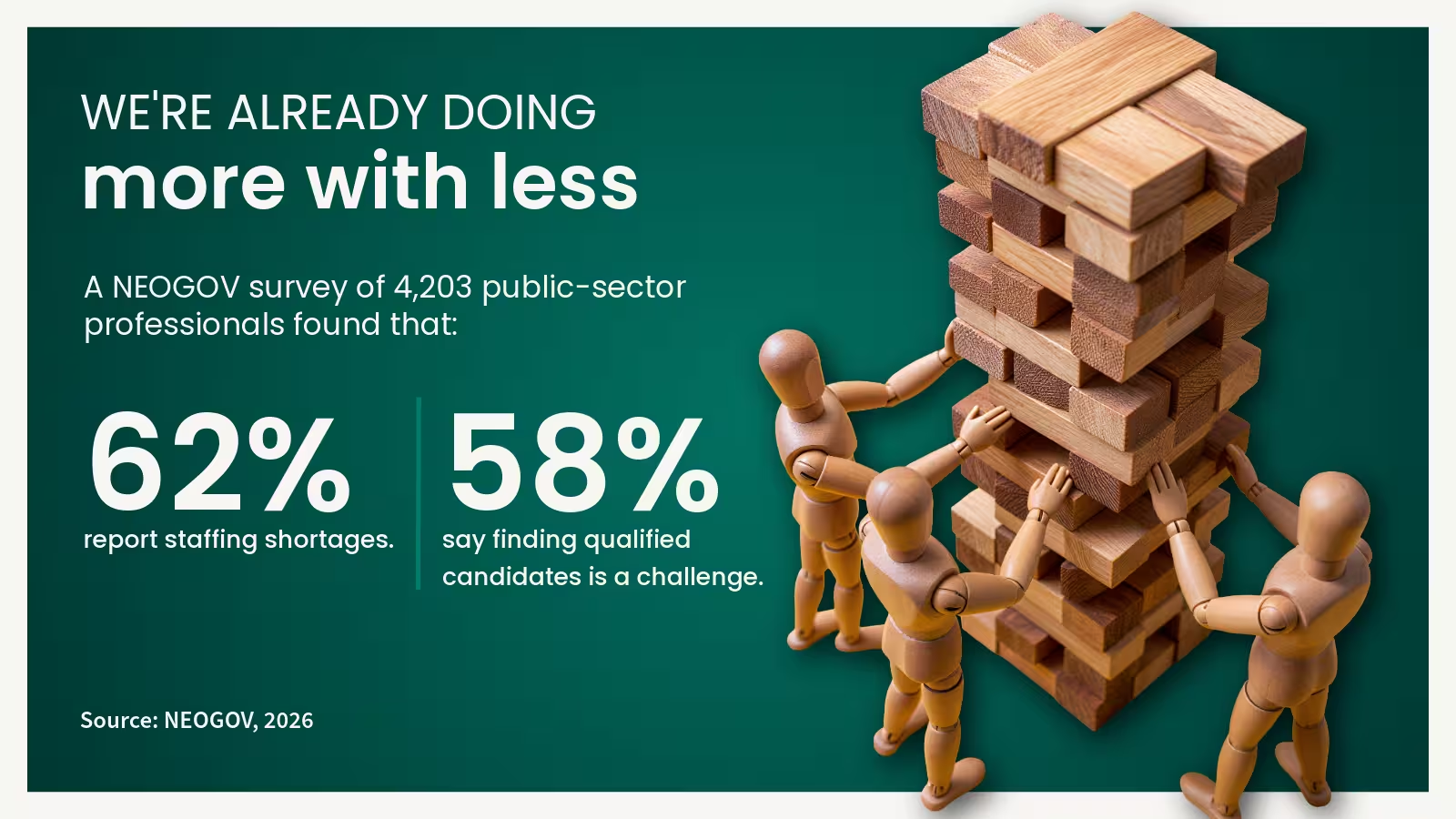
The other trend worth paying attention to is the local government workforce. NEOGOV's "Top 5 Public Sector HR Trends Shaping Government Teams in 2026" shows that workplace strain is becoming the norm. 62% of survey respondents reported staffing shortages. 58% said that finding qualified candidates is a challenge. Those two stats, plus resource constraints that make it difficult to compete with private-sector pay, create pressure to find new ways to work. Money and people are harder to come by, while the public still expects the same level of service. That combination makes new ways of creating capacity worth a look.
Getting Shovels in the Ground
Thankfully, it is easy to be curious about the technology available to local government. It has never been better. I've previously written about all the AI worth exploring, but given the housing crisis, permitting is a useful case study in how local government can add capacity and get shovels in the ground.
It's easy for politicians to rant about red tape, but a couple of academics who studied development approval times in LA put it plainly, in Stuart Gabriel and Edward Kung's "Development Approval Times and New Housing Supply: Evidence from Los Angeles," published in the Journal of Urban Economics: "Results indicate that a 25 percent reduction in approval times would have increased the rate of housing production in Los Angeles between 2010 and 2022 by 12.7 percent, simply by pulling forward in time the completion of projects already begun. The production gains are even larger upon accounting for the role of approval times in incentivizing new development." That confirms what every developer pitching City Hall bemoans: the lags in approval times are real. They limit supply and make housing more expensive. Let's take a look at what's happening in three big cities across the country.
Three Cities, Three Different Calls
Honolulu is experimenting with CivCheck, an AI tool that screens residential permit applications for errors and code compliance. The early results are notable. Applications using CivCheck averaged 32.5 days to a permit decision, compared with 73 days for applications that did not use it. The number of plan review cycles, the joy of every developer, dropped from 3.4 to 1.4. The average number of corrections fell from 23.5 to 7.7. The sample is still small, but the results were promising enough that Honolulu is expanding use of the technology. Honolulu went on to win a 2026 AI 50 Award for the work.
The effects of delay can be felt in the municipal budget too. According to Honolulu Civil Beat, residential turnaround times have improved, but high-value commercial projects remain stuck in review. City fee revenue fell nearly in half, from $24.6 million to $12.75 million, even as permit volume rose 40 percent. In a resource-constrained local government, every dollar counts.
It's not just getting the technology, though. The right processes need to be in place for it to be effective. An interview with two of Austin's development leaders, Jose Roig and Laura Huffman, published by McKinsey as "Accelerating Permitting: Lessons from the City of Austin," illustrates this in practice. Roig led Austin's Development Services Department through the transformation, and Huffman, who also helped lead it, said in the interview that the city didn't want to "pour new technology on a bad process." The city paused its rollout until the underlying process itself was fixed.
It's funny because as soon as I read that, I thought of imagined conversations from some of the vendors I worked with, "Jerry, if you had just fixed this obvious problem, we'd be four weeks ahead."
"Curiosity doesn't mean saying yes to everything."
Seattle piloted the same CivCheck software Honolulu uses, and the early results looked good: roughly 87 percent accuracy on completeness checks, 92 percent on design-compliance checks, and close to a 50 percent reduction in intake review time. And Seattle, as of its most recent report, still hasn't adopted it. City officials said they weren't ready and are still working through funding and logistics before going further. Taking a serious look doesn't require saying yes; sometimes the answer is "not yet."

Take the Call
I was always too busy to take a call from a vendor.
"The vendor hall at the conferences always feels like a junior high school dance."
But after stepping away for a bit, I can see that I ignored those things at my own peril. I underestimated what a good product could do for local government. Whether it is technology attached to a car to inventory code violations and potholes, or software that cuts turnaround times, some of these products can make jobs easier. It left me wondering why we still ask overworked staff to spend time on work that technology can now do.
And vendors: Nudge cities to ensure that the right people are in the room for the demo. When I was managing, I'd always be surprised when I'd get an email from a sewer-vac truck company. I'd think, "I just learned what a Phillips screwdriver was a few weeks ago." Just because I had signing authority didn't mean I should be part of the early discussion. That mismatch needs to be addressed better on both sides. I think back to telling a former frontline coworker about a new technology and watching his jaw drop. He knew better than I did whether we were fixing the process or just adding technology to it.
Worth a Look, Not a Yes
All of this has changed how I think about technology in local government. That doesn't mean every new product deserves a contract, or that every problem needs a technology solution. But with money tight, people hard to find and the work still needing to get done, some of these tools may create capacity where local governments need it. The people who know the work best can help determine which ones. At the very least, it's worth a look.

Jerry Gabrielatos spent over a decade in local government leadership, including as City Manager of Beloit, Wisconsin and West Linn, Oregon, and Assistant City Manager of Albert Lea, Minnesota. Since stepping away from city management, he's turned his attention to the technology now reaching city hall. He writes for Civic Marketplace about what's worth a city's time, not what's worth a vendor's pitch.



.avif)











.avif)






.avif)