
From Convenience to Control: Rethinking Public Procurement in the Age of Marketplaces

The convenience of one-click purchasing is now available in public sector procurement. Entities are buying billions of dollars worth of everyday supplies through the same commercial platforms folks use to shop online from home.
This routine procurement is vital to ensure the critical services provided by local entities keep running, but there is growing evidence that ultra-convenient purchasing comes with hidden costs for government departments.
The Institute for Local Self-Reliance’s (ILSR) recent report, ‘Turning Public Money into Amazon’s Profits’, found that government purchasing on Amazon has increased fourfold since 2016. It argues that Amazon Business’ growing role in routine public sector purchasing has driven up overall costs, reduced transparency, and eroded competition by eclipsing better-performing, more accountable independent suppliers.
Although the ILSR findings focus on Amazon Business, they point to a broader structural issue in public procurement. Procurement platforms are meant to help deliver on the principles of value, transparency, and accountability when spending taxpayer money. But many remain slow, fragmented, and difficult to use for everyday purchases.
However, when ultra-fast purchasing platforms become the default channel for routine public spend, they start to function as de facto procurement systems, but without the safeguards that public procurement requires.
How convenience displaced discipline
To reduce the administrative burden on staff for routine, low-risk transactions, purchase cards (P-cards) and below-threshold buying rules were introduced and have been standard practice for most entities since the 1990s. These programs were deliberately capped with limited transaction values, had category restrictions and audit requirements, and required escalation to competitive processes above defined thresholds.
These rules have not changed, but the rise of convenience-centric online marketplaces such as Amazon Business has changed how they work in practice, argues the ILSR. What used to require navigating multiple suppliers and processes can now happen in a single click, which becomes a recurring habit.
By condensing supplier discovery, price comparison, and checkout into a single interface, these platforms limit how intentional procurement departments can be with their procurement strategy. These platforms control their own search, ranking and pricing mechanisms to optimize outcomes for their own business models. Over time, this has led to more procurement spend funnelled through algorithms that do not always align with the governance principles required by local government.
More worrying is the finding that many of these transactions are not itemized or visible in entity checkbooks. Many entities lack the data needed to identify spending patterns, or to spot opportunities for routine purchases to be procured in bulk and/or at lower cost through local suppliers or competitive contracts. Across many entities’ accounts, purchases only show up on statements with the marketplace itself ( for example, Amazon) as the supplier of record, rather than showing what item was purchased or the actual supplier.
Individual public sector buyers may technically be maintaining compliance with transaction limits and category restrictions, but without itemized reporting, entities have lost the ability to exercise strategic oversight. This is now a significant issue because of the scale of the spend going through these platforms. The Amazon Business platform took $2.2 billion in revenue in 2023 from the public sector.
The impact on entities
As a result, entities are now seeing dynamic pricing, weakened competition, limited auditability, and less supplier choice.
Audit and compliance exposure
When large volumes of purchasing flow through P-cards and closed, commercial platforms, executive teams have limited audit trails and ability to demonstrate lawful, competitive procurement.
In Oklahoma, for example, P-card purchases with Amazon grew nearly tenfold between 2010–2017, according to ILSR analysis, to over 80,000 transactions annually. This volume across multiple cards can make it difficult to provide a clear audit trail capturing all the required information about purchases. Centralizing purchases via one account in 2019 cut Oklahoma State’s Amazon spend by 75%.
Loss of price control and budget predictability
Dynamic pricing and opaque supplier selection make it harder for finance leaders to forecast costs and manage long-term budgets effectively.
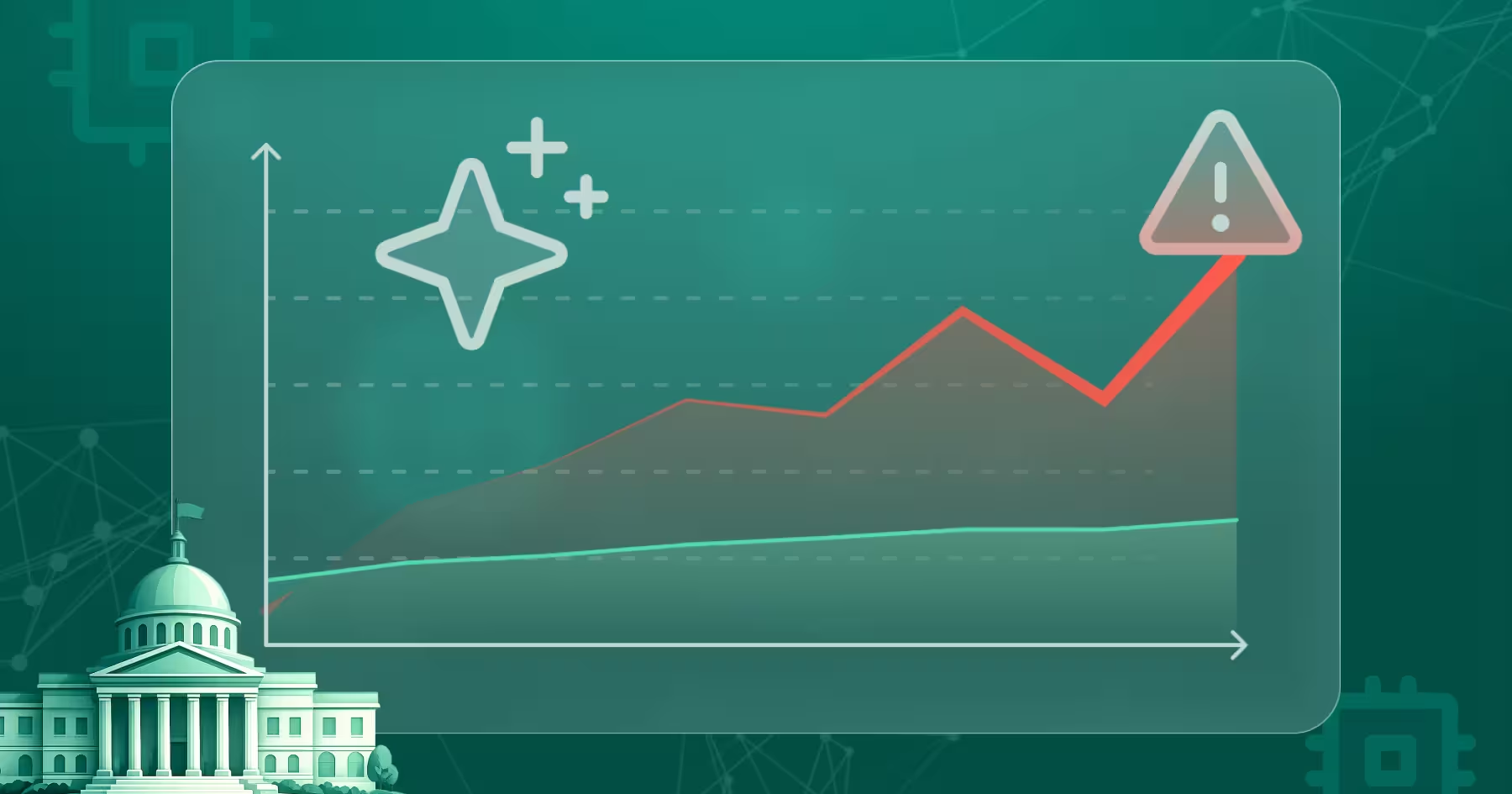
The ILSR found, for example, that for the top 100 most frequently ordered products, Amazon charged prices that varied by more than 130% for identical products, meaning some entities paid over twice as much as others, sometimes seeing significant price increases on the same day.

Lack of competition
As ultra-convenient marketplaces become the default for high-frequency, high-volume procurement, entities end up purchasing from the exact same suppliers every time as they are ‘boosted’ by marketplace algorithms. This limits supplier diversity and reduces competition.
A lack of competition weakens price discipline and reduces resilience in supply chains, which makes it harder for entities to demonstrate value for money. When the public or elected officials ask where public money is going, lacking line-item visibility into spend is not a defensible position. This also means it's much harder for entities to track the spend that they are putting back into their local economy, and to be intentional about spending on local suppliers.
Restoring transparency to routine spending
Any viable alternative must start from a simple reality: Entities cannot afford slow procurement.
Algorithms themselves are not necessarily the issue. But they require explicit guardrails and incentives that align the buying experience with entities’ responsibilities. Search rankings, ‘default’ buying options and dynamic pricing may be rational for a retailer, but they are platform features, and can change without notice.
Instead, a public sector procurement platform needs to treat governance and accountability as a design requirement, not a constraint, in order to properly serve entities’ needs. That does not have to come at the expense of a convenient purchasing process, but this convenience must be a result of intentionally built marketplaces that follow governance.
Platforms must offer quick and convenient routine purchasing in addition to – not at the expense of – competition, transparency, and accountability. This is the model Civic Marketplace is building with its partners.
The Civic Marketplace advantage
Civic Marketplace can support entities with competitively awarded cooperative contracts, multi-vendor catalogs for the top-recurring categories of purchasing, with fixed pricing and service standards.
Focused on enabling purchasing from local and regional suppliers, the platform also helps local businesses with training and onboarding to help them sell to entities.
Civic Marketplace makes sure you are in control at every step of the procurement process and gives your team a clear view of every quote and every decision, all in one place.
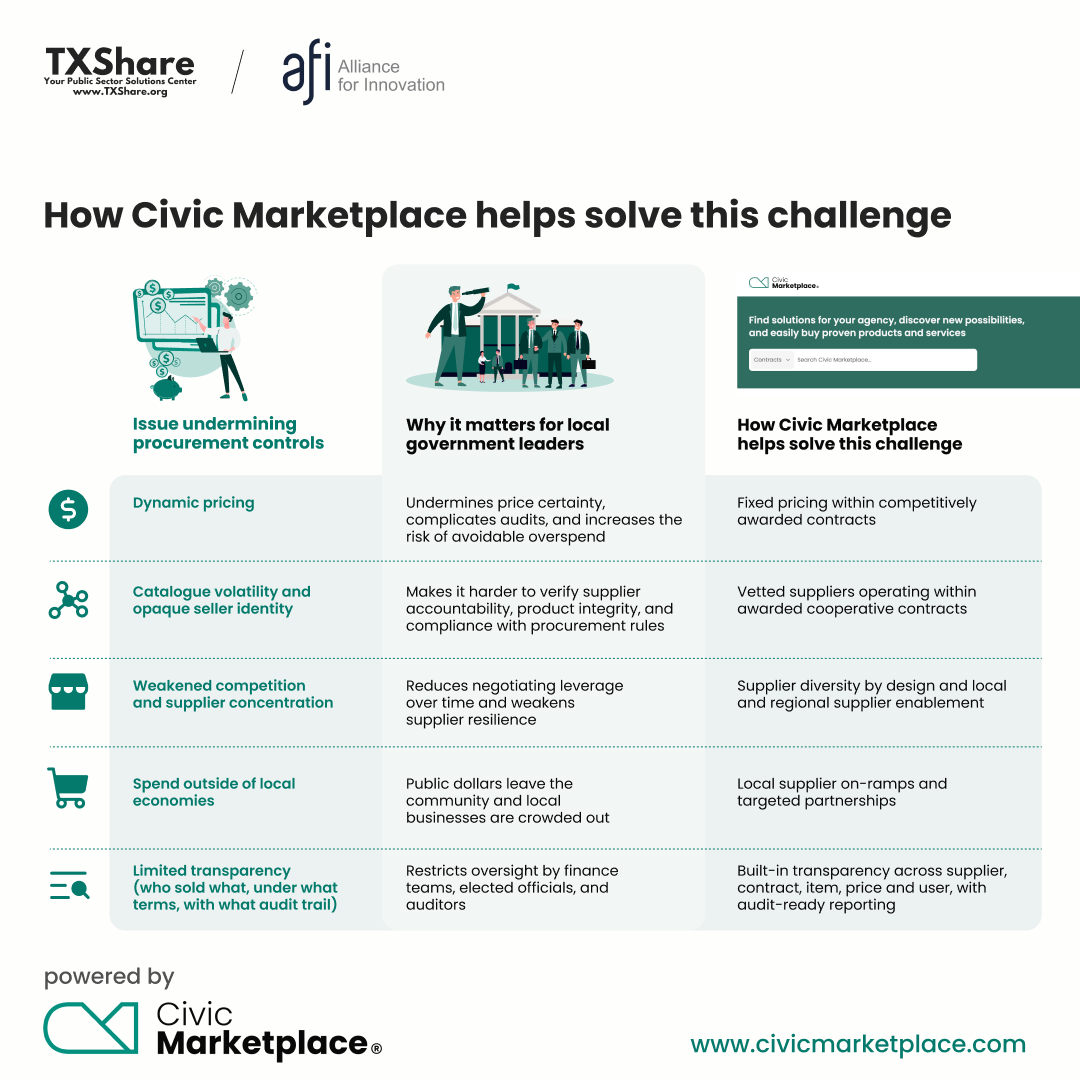
The Alliance for Innovation collaborates with Civic Marketplace to make public procurement faster, smarter, and cheaper. Civic Marketplace gives you a practical way to find and access AFI’s cooperative contracts within a marketplace designed for local government, with fixed pricing, supplier vetting, and governance built in.
For example, the AFI’s Batteries, Power, Lighting and Solutions allows entities to purchase high-frequency battery and power essentials from locally owned Batteries Plus store franchises nationwide. Its fixed and transparent pricing sheet provides cost savings of up to 45% off list price, and enables entities to purchase from local stores to keep spend circulating in the community.
If your entity isn’t already a member of the AFI, you can learn more about membership here.
To explore how your entity could lower costs and bring transparency to routine spend, get in touch with Civic Marketplace and one of our ex-public sector procurement leaders will guide you through the platform.

.avif)
Michael Wilkes, Executive Director at the Alliance for Innovation, is a seasoned public sector leader who served as City Manager of Olathe, Kansas for 27 years – the longest tenure in the city’s history. Over a four-decade career in local government across Oregon, Georgia, and Kansas, he has led fast-growing communities and championed innovation in municipal management, earning multiple awards for excellence in public service.



.avif)








.avif)


.avif)