
Technology Foresight Council: AI Projects Reshaping Cities
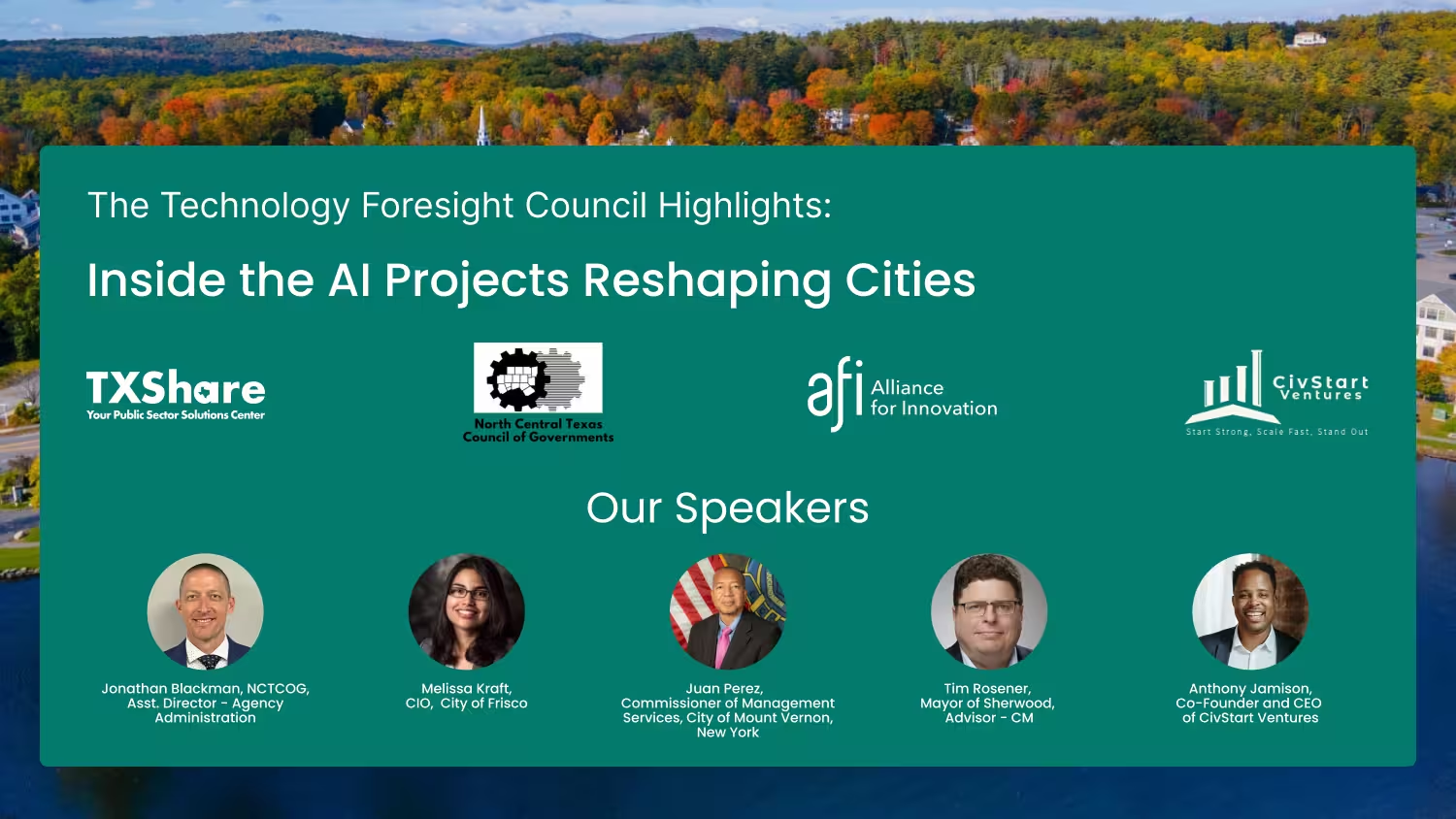
The first Technology Foresight Council (TFC) session of 2026 took place on Wednesday 21 January, featuring thought-provoking discussions and practical takeaways for local government leaders exploring how AI projects can reshape cities, moderated by Tim Rosner, Mayor of Sherwood, Oregon.
TXShare’s Jonathan Blackman opened the session by reiterating the Council’s purpose and mission: to facilitate peer learning and share real implementations and lessons learned.
The session built on the success of the last TFC event, where IT Director Scott Persons shared how they rolled out AI for internal efficiency gains in Tooele County, Utah.
Here are the key practical takeaways from AI projects reshaping cities, from resident engagement to city operations, with case studies from the City of Frisco, Texas and the City of Mount Vernon, New York.
Lessons from The City of Frisco, Texas
The City of Frisco is one of the fastest growing cities in the United States.
“Our demand is increasing faster than our ability to add staff,” Melissa Kraft, Frisco CIO explained. “But residents expect faster responses, and clearer communication.”
Frisco’s voice AI project emerged as a result of an intentional audit of the operational pain points within the organization. “We started with one simple question – where are people spending time listening, typing, or repeating the same work?”
When it became clear that multiple departments were facing significant voice and transcription workloads, they honed in on one area – the traffic departments – rather than attempting to immediately scale a solution across the entire organization.
Frisco used a four-part framework to evaluate the technology and ensure it met their overarching goals, across: organizational excellence; citizen engagement; encouraging micro-mobility; and public safety. The goal was to use AI as an efficiency multiplier, not a replacement for people. “We always say AI is there to augment work,” said Melissa.
Melissa explained that it was an advantage that the chosen supplier was already vetted and trusted in Frisco through the NCTCOG and an awarded TXShare cooperative contract, enabling a quick rollout.
Frisco worked with TXShare supplier WhiteGloveAI to implement Voice AI transcription technology and built it into a unified Citizen Relationship Management System (CRMS) that organizes, routes, and analyzes resident interactions across departments. Automating this process saves Frisco’s traffic engineers 15–20 staff hours per week and improves response consistency, data quality, and trend visibility. “Now people can focus on the higher value interactions and decision making,” Melissa said.
For a high-growth area like Frisco, implementing a sustainable solution that could eventually scale was really important. Frisco is now planning to expand the technology to multiple departments.
Lessons from The City of Mount Vernon, New York
Juan Perez, the City of Mount Vernon’s Commissioner of Management Services, shared how the city rolled out an AI-powered assistant in its Buildings Department.
Juan shared that the Buildings Department was the perfect place for the city’s first AI solution. It was overwhelmed with the high-volume of inquiries, particularly those received outside business hours, but “[it] has very set processes, and by taking those processes and working with the department, we were able to transcribe those functions into an AI platform.”
A key challenge they faced was finding a supplier than could integrate AI into their existing OpenGov system of record, until they came across TXShare supplier Readyly. The result was an AI agent that could answer complex queries about local and state codes, permits, and zoning. And though the tool was only recently implemented, Juan shared that the impact is already being felt.
“Using the Readyly application has, in effect, allowed us to respond to public inquiries on a 24-7 basis,” said Juan. “It's been a force multiplier for us.” Seeing the success of the project, other departments are keen to apply it to their workflows.
Juan stressed that their work with the Buildings Department was effective because they had a laser-focus on a specific problem. “We wanted to make sure that we did it in a safe, repeatable fashion, and doing it [first] within the buildings department allowed us know exactly what we needed to do, how we needed to apply it, and tackle specific targets.”
Key takeaways
In the Q&A that followed, Juan and Melissa shared what they learned, and what they would’ve done differently:
- Start with people, not tools. Both cities emphasized that leadership support and departmental culture matter as much as the technology itself, especially early on.
- Narrow the problem before choosing AI. Melissa stressed starting with a clear operational problem and scaling only after proving value, while Juan warned against analysis paralysis and advised focusing on one high-impact target.
- Expect a productivity lag during adoption. Melissa highlighted that teams need time to learn, test in parallel, and align on what “good enough” looks like before AI delivers real gains.
- Change agents accelerate adoption. Juan noted that enthusiastic early adopters in the Buildings Department became advocates, helping spread momentum across the organization.
- Testing takes longer than expected. Both speakers reflected that understanding what AI can’t do requires as much effort as testing what it can do.
- Invest in training early. Juan underscored the importance of educating staff upfront to set realistic expectations and avoid misconceptions about AI capabilities.
What holds agencies back from AI adoption?
Anthony Jamison, co-founder and CEO of CivStart Ventures, which connects local governments with GovTech solutions, explained that he often sees AI projects stall because the problem a city is trying to solve is framed too broadly.
Often, cities are not constrained by a lack of AI tools, but by signal overload from vendors, unclear ownership of projects across departments, and procurement friction and pilot fatigue. He urged cities to adopt an intentional and disciplined approach to AI implementation, whether across resident engagement, internal workflows, or after-hour operations. “It's about creating a safe front door for early problem discovery, where governments can explore options, reduce noise, and stay in control.”
Cooperative contracts that have been competitively awarded to vetted suppliers and guarantee compliance are a key tool for that safe early discovery. Organizations such as TXShare and Civic Marketplace offer the infrastructure needed for contract matching and incremental implementation, so local governments can take those first steps with confidence.
Join the Technology Foresight Council today
The TFC is a collaborative initiative led by the Alliance for Innovation (AFI), the North Central Texas Council of Governments (NCTCOG) and TXShare, with support from Civic Marketplace. It is a forum for exploring the future of government and technology, shaping procurement pathways, and amplifying transformative ideas through collaboration between the public sector, private innovators, and AI-driven thought leadership.

Register your interest to be notified about upcoming TFC events, and gain insight into live case studies and inspiring collaborations between local governments and today’s tech innovators.




.avif)






.avif)




.avif)