
What AI Tools Can Help Government Procurement Teams Analyse Pricing and Compare Contracts?

Table of contents
The right tool depends on whether your Entity needs line-item pricing visibility, clause comparison, workflow auditability, or basic research support.
No single platform covers every need. Civic Marketplace Platform, for instance, is built for Entities comparing Suppliers and cooperative contracts, with a Pricing Agent for pricing-document analysis. Agencies with highly specialized federal clause review may still need a dedicated contract-review tool alongside it.
Which AI tools fit which procurement workflow
Spend analytics platforms unify fragmented spend data, classify transactions with AI, and surface savings opportunities across an Entity's full purchasing history. JAGGAER's spend analytics platform, for example, uses NLP and machine learning to classify purchases across multiple ERPs, benchmark commodity pricing, and flag off-contract spend. Coupa and Suplari work similarly, connecting contract data to spend performance so Entities can see where contracted pricing is being by passed.
Contract intelligence tools, including Gavel Exec and Sirion, extract clauses, compare contract terms, and benchmark pricing against market norms using NLP. GavelExec is purpose-built for regulated contracting environments, trained onFAR, DFARS, DEAR, VAAR, HUDAR, and agency-specific flow-down requirements. That is what separates dedicated contract AI from generic summarization tools.
Process intelligence platforms like Celonis monitor procurement workflows in real time and flag off-contract purchases before they reach Suppliers. The DHS Procurement Innovation Lab took a different approach, building an AI market research tool that scrapes public databases to help contracting officers identify potential Suppliers, past work, and business size data, speeding up vendor identification.
Appian's government contracting blog documents ten applications where AI adds value for government procurement teams, including market intelligence and pricing insights, enhanced bid evaluation, predictive analytics for cost and performance, and NLP-powered contract analysis. These applications span every tool type listed above and help clarify which one addresses which procurement question.
General-purpose LLMs available through GSA's OneGov Strategy offer ad-hoc pricing research and contract summarization.
Comparison table: Which tool type fits your agency's pricing and contract workflow?
OpenContracting Partnership research (2025) reports that public sector organizations are favoring off-the-shelf licenses over custom builds.
When a general-purpose LLM is enough, and when you need procurement-specific AI
A general-purpose LLM is often the right starting point. For lightweight tasks, ad-hoc pricing research, drafting scope-of-work sections, or summarizing a contract for a non-specialist audience, the GSA-negotiated tools are capable at near-zero cost.
The decision shifts when the task requires an audit trail. Generic tools lack procurement-specific workflow controls, explainability logs, and integration with your Entity's contract or spend data. Brian Esposito, Deputy Secretary of Procurement at Pennsylvania Department of General Services, frames the operational reality directly in StateTechMagazine: "AI can be used to streamline the scope of work, ensuring that you are putting out scopes of work that are technically sound, that limit external questions and inquiries." But that benefit requires tools built into a documented workflow, not a standalone chat window.
Needs that exceed a general-purpose LLM include structured contract comparison with a documented basis of award, FAR-trained clause review, integration with cooperative contract pricing data, and any analysis that will be cited in a source-selection memo or audit file.
Our Pricing Agent addresses exactly this middle ground. When the task is pricing-document analysis and comparison inside a public-sector procurement workflow, Pricing Agent pulls pricing data into a structured, auditable format rather than returning a conversational summary. That distinction matters when an auditor asks how you reached a price determination. One honest limitation: Pricing Agent is designed for cooperative contract pricing comparison, not deep FAR-clause analysis of complex federal solicitations.
What government buyers should check before trusting AI output on price or contract terms
Transparency and explainability are the two non-negotiable requirements for AI-assisted procurement decisions. That patchwork matters: an AI tool that meets your state's policy today may need re-evaluation next budget cycle.
Zachary Christensen, Deputy Chief Cooperative Procurement Officer at NASPO, puts the standard directly in StateTech Magazine's April 2025 coverage: "When a tool is making a decision for that entity — if you're using a tool to decide who gets a contract — you have to be able to show how that decision was made." That means documented audit trails, role-based access controls, and human review before any award decision is finalized.
USSOCOM's disclosed AI approach offers the clearest federal model: AI may summarize proposals and flag compliance issues, but all final evaluation judgments and source-selection decisions remain with government personnel. That human-in-the-loop requirement is not optional for most public Entities.
Data handling is equally important. Entities should verify that any AI tool processing pricing or contract data meets FedRAMP, StateRAMP, or agency-specific standards. The National Law Review's analysis of AI in federal contracting highlights source-selection and proprietary-information protections under FAR 3.104, organizational conflict-of-interest exposure, and the need for human review of AI-generated content as primary legal concerns.
Real public-sector proof: where AI has already found pricing savings
Named case studies, not vendor projections, are the clearest evidence that AI pricing analysis works in government.
Oklahoma's Office of Management and Enterprise Services deployed Celonis process intelligence across all 122 state agencies. The results, documented in 2025, were concrete: more than 24,000 purchase orders worth $4.58 billion were reviewed before reaching vendors, and over $174 million in potential savings were identified by maximizing use of statewide contracts. The AI flagged POs using incorrect exemption codes or going out as sole-source when contracted Suppliers were available.
Euna Solutions' data tells a complementary story. Per the 2025 State of Public Procurement Report, procurement teams save an average of nearly $35,000 per project, and the AI-powered savings advisor has saved agencies over $4.5 million through cart optimization at checkout.
What these cases prove: AI creates measurable value when it is tied directly to contract use, spend visibility, and actionable comparison. Summarization alone produces no savings. The Oklahoma deployment worked because Celonis had access to live PO data and could flag each transaction against existing contract pricing before the order was placed.
Why cooperative contracts matter in AI pricing analysis for local government
Many local Entities do not start a pricing analysis from scratch. They need to compare existing cooperative options, validate best value against pre-competed pricing, and document why one contract path is more defensible than another.
The challenge is visibility: most Entities overpay because they don't know which cooperative vehicles cover their specific purchase category.
AI-powered procurement tools can cross-reference pricing across multiple cooperative vehicles including NASPO ValuePoint, Sourcewell, OMNIA Partners, and HGACBuy, surfacing the most favorable pre-competed option without requiring a new solicitation. Carahsoft's analysis of Euna Solutions' approach shows how AI savings advisors automatically flag lower-cost alternatives and identify off-contract purchase sat the point of checkout.
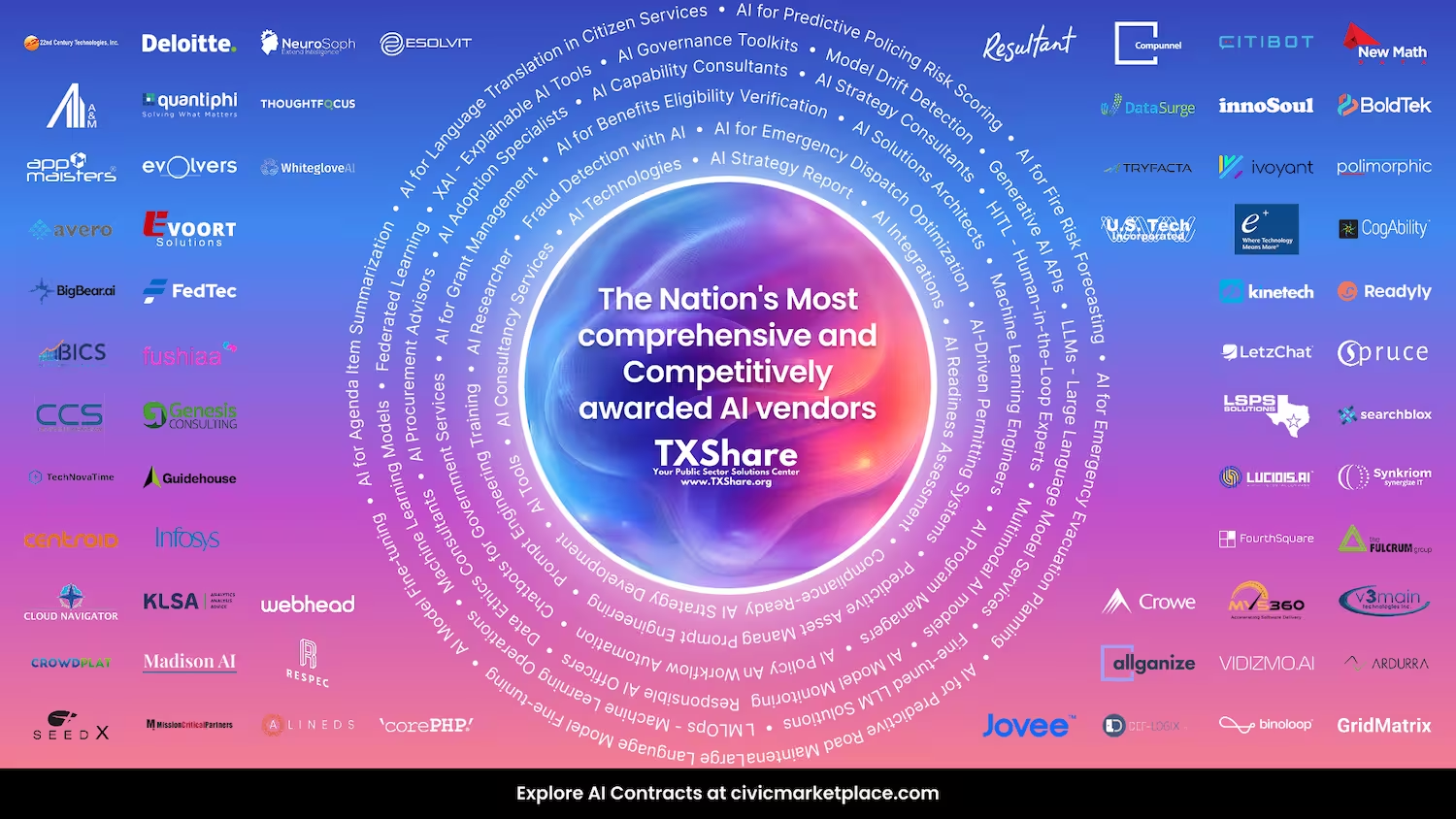
This is where the Civic Marketplace Platform and TXShare Cooperative Contracts become directly relevant. Through our partnership with the North Central Texas Council of Governments (NCTCOG), we serve more than 200 local governments across 16 North Texas counties. Entities can browse pre-competed, compliant contracts, use Pricing Agent to compare pricing documents side-by-side, and produce an audit-ready record of their basis of award. In July 2025, TXShare and Civic Marketplace launched an AI Solutions Cooperative Contract and AI Consultancy Cooperative Contract covering more than 70 use cases, giving Entities a compliant path to procure AI Suppliers without running a new solicitation.
If your pricing-analysis workflow depends on comparing cooperative contract options rather than building a new RFP from scratch, explore whether a cooperative marketplace approach fits your procurement process.
References
- StateTech Magazine. "AI in Procurement Is a GameChanger for Government." https://statetechmagazine.com/article/2025/04/ai-in-procurement-government-perfcon(April 2025)
- Inventive AI. "Best AI Tools for Procurement Teams2026." https://www.inventive.ai/blog-posts/ai-tools-procurement-teams(2026)
- GovDash. "Top 5 AI Solutions for GovCon2026." https://www.govdash.com/blog/top-5-ai-solutions-for-govcon-govdash-takes-the-lead(2026)
- Gavel. "AI Contract Review Software for Government Contracting and Public Sector Procurement." https://www.gavel.io/resources/ai-contract-review-for-government-contracting-and-public-sector-procurement(2025).
- National Law Review. "Artificial Intelligence Use in Federal Contracting Proposals." https://natlawreview.com/article/navigating-federal-solicitations-artificial-intelligence(2025).
- GSA. "Buy AI." https://www.gsa.gov/artificial-intelligence/buy-ai (2026).
- Open Contracting Partnership." The Surprising Shifts in How the Public Sector Is Buying AI." https://www.open-contracting.org/2025/11/10/the-surprising-shifts-in-how-the-public-sector-is-buying-ai-and-what-policymakers-can-do-about-it/(2025).
- Appian. "Improving Procurement with AI in Government Contracting." https://appian.com/blog/acp/public-sector/ai-in-government-contracting (2025).
- Celonis. "Oklahoma State Customer Story." https://www.celonis.com/solutions/stories/oklahoma-state-procurement (2025).
- Euna Solutions. "2025 State of Public ProcurementReport." https://eunasolutions.com/resources/euna-solutions-releases-2025-state-of-public-procurement-report/(2025).
- Carahsoft / Euna Solutions. "Smarter Spending: HowState and Local Governments Are Using AI-Powered Procurement Tools." https://www.carahsoft.com/blog/euna-smarter-spending-how-state-and-local-governments-are-using-ai-powered-procurement-tools-to-maximize-cost-savings-blog-2025(2025).
- NPPGov. "AI + Cooperative Contracts = New Era for Procurement in SLED." https://nppgov.com/ai-cooperative-contracts-new-era-in-public-procurement/(2025).
- Burr & Forman. "Should the Government Use AI Tools to Evaluate Contract Proposals?" https://www.burr.com/government-contracting/should-the-government-use-ai-tools-to-evaluate-contract-proposals(2025).


.avif)







.avif)

.avif)