
Technology Foresight Council: Scaling AI with Governance, Enablement and Access
The Spring Technology Foresight Council brought together local government leaders and technology practitioners to share their insights on how agencies can adopt and scale AI usage responsibly, with the right governance, skills and infrastructure.
Governance, Enablement, Access
Tim Howell, Chief Innovation Officer at the North Central Texas Council of Governments (NCTCOG), opened the session by highlighting the reality many local governments are already facing:
“AI is no longer something we’re planning for. It’s something we are reacting to.”
Tim introduced NCTCOG’s three-pillar approach to scaling AI: Governance; Enablement; and Access. Governance provides the guardrails and accountability needed to manage risk and maintain trust. Enablement focuses on equipping staff with the skills and confidence to use AI effectively. Access removes barriers, ensuring teams can adopt the right tools without unnecessary friction.
To support this approach, NCTCOG developed an innovation sandbox — a controlled environment where teams can test and prototype AI solutions before deploying them more widely. As Tim described it, this allows organisations to “start to tinker without having everything figured out,” while still understanding risks, controls, and operational implications early.
Preparing for an agent-driven future
Dustin Haisler, Chief AI Officer at Darwin AI, described a future in local government services where AI is not only assisting with tasks, but increasingly able to take action on behalf of citizens.
However, Dustin said that some of today’s AI usage sits outside formal oversight, whether through embedded features in existing software or what Dustin described as “BYOAI” — where individuals bring their own tools into workflows.
“We are in this collision course where technology is moving faster than a regulatory environment.”
This creates a growing gap between usage and governance.
But rather than trying to restrict usage, Dustin’s view was that local governments need to focus on two immediate priorities: understanding where AI is already in use, and setting clear expectations for how it should be used in practice.
“It can be a huge enabler of human capital and human potential when used responsibly… but we need to build the infrastructure — and that infrastructure starts with governance.”
In this context, governance is not a constraint on innovation. It is what allows agencies to move from informal, fragmented use towards more consistent and scalable adoption.
Lessons from Manatee County, Florida
Manatee County offers a clear example of how these principles can be applied in practice, starting with a focused, resident-facing use case.
Lacy Pritchard, Records and Information Management Manager for Manatee County, Florida, shared how the county jumped on the opportunity to introduce Cortez – an AI-powered chatbot – during their project to redesign their website. “The website was brand new, so the data was good,” explained Lacy. ”It was a win for leadership that wanted us to implement AI, and also a win that we could get for our citizens.”
The new website was built around services on offer to citizens rather than departmental structures. “Citizens don't care if a pothole being filled is done by public works department or that the water is delivered by the utilities department or veteran services is in community and veteran services,” said Lacy. They just want answers to their questions.
In the few months since launch Cortez has answered 51,000 questions, and saved around 48,000 calls to the 311 call center.
Just as important was an unexpected benefit: Cortez helped identify unanswered resident questions and content gaps on the website. That gave the county a new feedback loop for improving digital service delivery. “We were able to go in and filter out those questions and divvy them up to department website editors to help them restructure our website so that next time someone asks that question, they're going to get an answer rather than be directed to 311.”
Looking ahead, Manatee County is already thinking beyond basic website support. Lacy outlined plans to expand Cortez into service request workflows, such as potholes, stop signs, and traffic issues, with the long-term goal of routing requests more directly to field teams. She also pointed to emergency response as a future use case, particularly during hurricane season, when surge support and fast public information becomes especially important.
Key takeaways from the Q&A
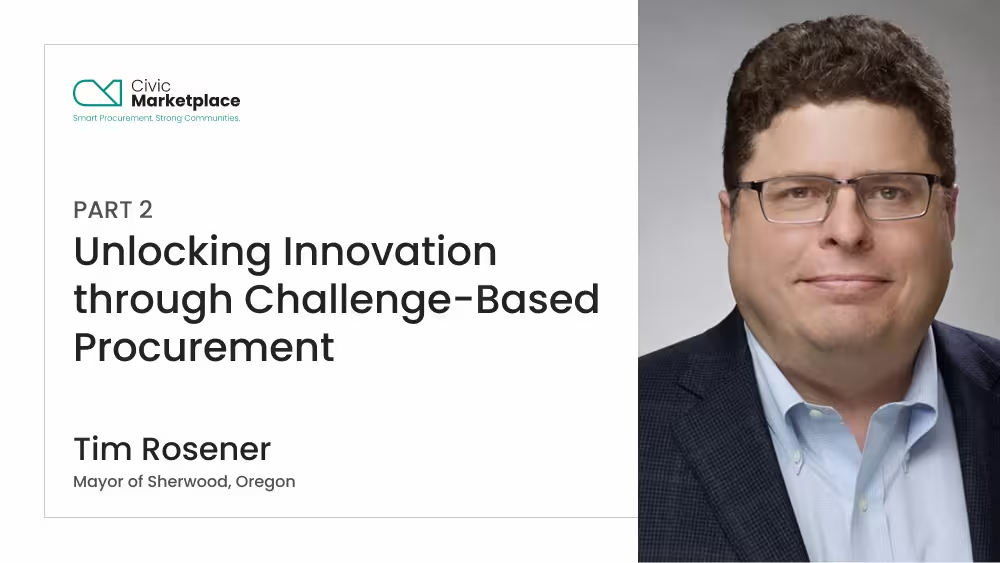
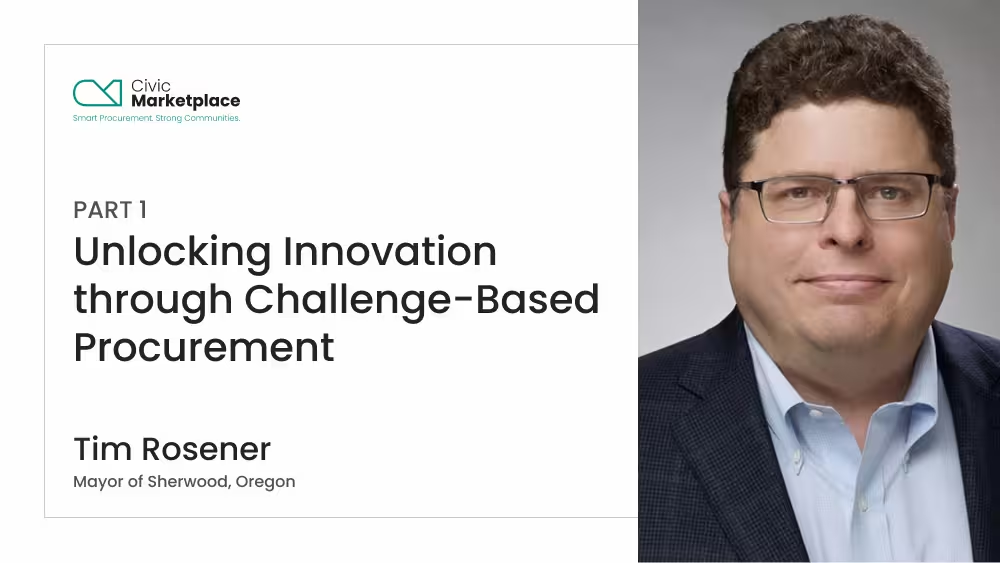
Moderated by Tim Rosener, Mayor of Sherwood, Oregon, the Q&A focused on the practical challenges local governments are facing as AI moves from experimentation into day-to-day operations:
- AI governance has to be cross-functional. Lacy Pritchard underscored that governance cannot sit with IT alone. Manatee County has a structured vetting and inventory process that now includes AI-specific questions for software reviews, as well as public records considerations and readiness for future FOIA requests. Tim described how at NCTCOG they have an AI committee with representation across departments and an AI champions model to spread learning and adoption through the organization.
- Sandbox environments help teams learn without overcommitting too early. Tim Howell explained that the sandbox was designed to test emerging technologies, allowing a team to validate assumptions, identify risks, and understand control requirements before scaling further. That approach matters because many agencies feel pressure to move quickly even when governance and tooling are still evolving.
- Human accountability does not disappear when AI enters the workflow. Dustin Heiser argued that as AI systems become more agentic, people remain responsible for the decisions, approvals, and outputs that move forward. If something inaccurate or inappropriate is published, responsibility still sits with the employee or team that authorised it, not with the tool itself.
- Smaller agencies should start with what they already have. For smaller organizations concerned about cost and complexity, Tim’s advice was to begin with AI capabilities already available inside existing Microsoft or Google environments, especially where enterprise controls are included. Look to form partnerships with neighbouring jurisdictions, universities, or leverage the expertise of cooperative purchasing programs as ways to reduce the burden of getting started.
Join the Technology Foresight Council today
The TFC is a collaborative initiative led by the Alliance for Innovation (AFI), the North Central Texas Council of Governments (NCTCOG) and TXShare, with support from Civic Marketplace. It is a forum for exploring the future of government and technology, shaping procurement pathways, and amplifying transformative ideas through collaboration between the public sector, private innovators, and AI-driven thought leadership.
Register your interest to be notified about upcoming TFC events, and gain insight into live case studies and inspiring collaborations between local governments and today’s tech innovators.





.avif)






.avif)



.avif)