How two cities made their websites work for every resident

Table of contents
At a glance
The questions every agency is asking
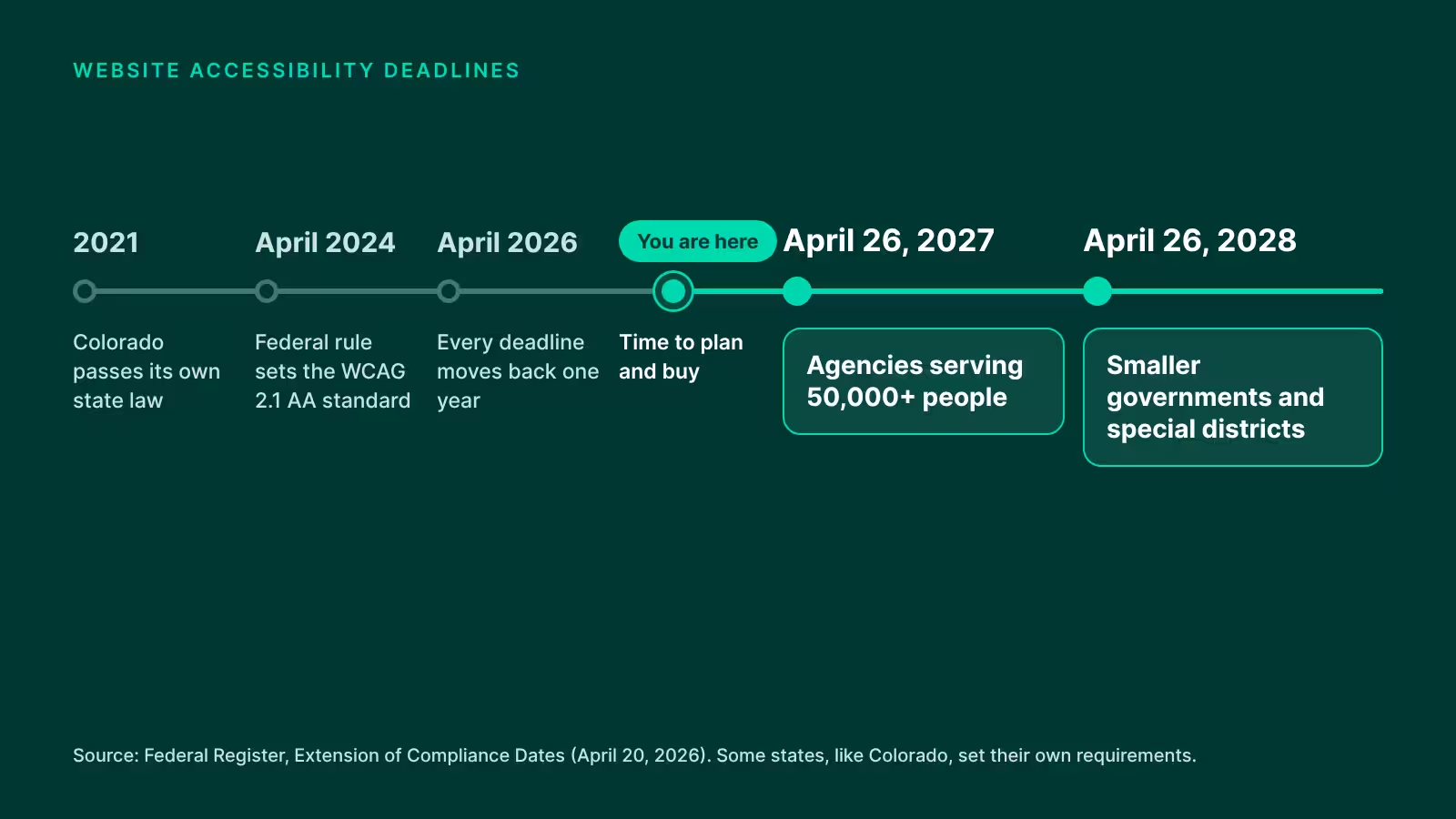
Every state and local government website in the U.S. now has an accessibility deadline. In 2024, the Department of Justice adopted a rule under Title II of the Americans with Disabilities Act requiring government websites, apps and online documents to meet a recognized accessibility standard (WCAG 2.1 AA). In April 2026, DOJ pushed the original dates back by a year. Agencies serving 50,000 or more people now have until April 26, 2027. Smaller governments and special districts have until April 26, 2028.
From city managers and clerks to IT directors and department heads, people across local government are sharing the same concerns about how to keep their entity’s websites accessible for all:
- "We have thousands of PDFs. Where do we even start?"
- "We don't have the staff or the budget for this."
- "The deadline got pushed. Can we wait and see if the rule changes?"
- "Do we just delete everything?"
You're not alone. The National League of Cities has pointed to "the cost and staff time necessary to ensure that online content is fully compliant," especially for smaller communities. In small-town listening sessions with the Small Business Administration, officials said they were weighing compliance against needs like "fixing city roads." In North Dakota, the head of the state's league of cities said the easiest way to comply "is probably to delete portions of your website and remove documents."
"Where they're really getting stuck is the scope of accessibility is so big that they don't know what to do," says Don Torrez, an independent ADA consultant who has worked with hundreds of local governments. "So often times they procrastinate."
It can feel like an isolating job, too. "It felt like it was a very lonely process," says Felix Albl, who manages Broomfield, Colorado's website. That changed when he started comparing notes with peers at conferences: "Everybody was in the boat together."
And that’s exactly what this piece aims to do: give you advice from others who’ve done it, so you don’t feel as alone if you’re feeling overwhelmed about how to manage a project of this size. Two cities with very different resources share what worked, in their own words, and how they answered each of those questions.
Why this matters, beyond the upcoming deadline
- Your website is your city’s first impression. "We consider the website like our front door," says Julie Story, Broomfield's Director of Communications and Engagement. Residents pay utility bills, apply for permits, sign kids up for soccer, reserve park space and look up election information online. For many of these, there's no private-sector alternative. If the website doesn't work for someone, the service doesn't either.
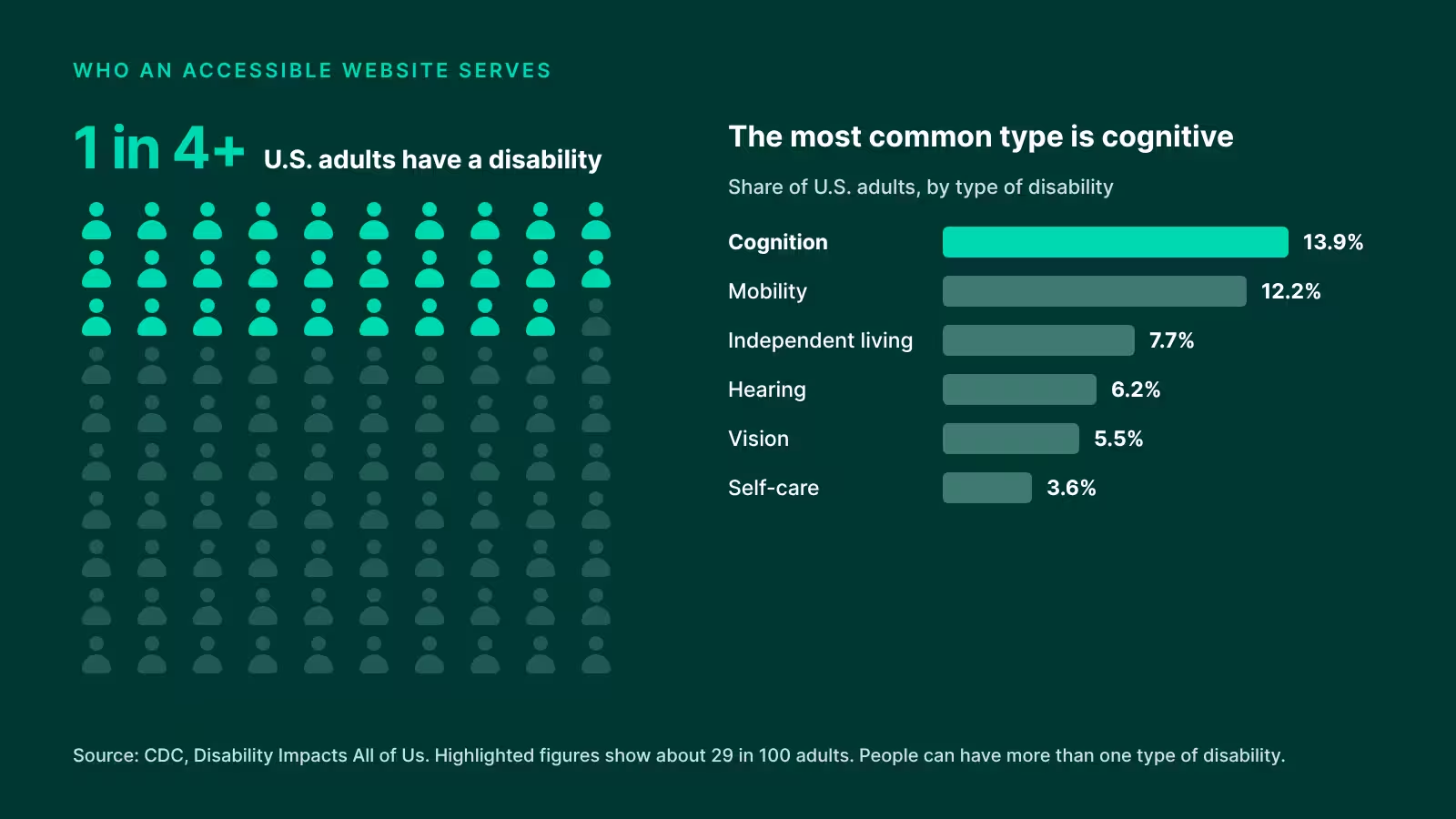
- It affects more residents than most people think. Nearly 29% of U.S. adults have a disability, according to the CDC. "If you imagine almost a third of people can't access programs and services of the government because they have a disability, that's a huge number," Torrez says. The most common type of disability is cognitive, which is why plain language and simple navigation matter as much as screen readers.
- It makes the site better for everyone. Clear headings, plain language and up-to-date pages help every resident, and under-the-hood, they also help AI tools and search engines like Google give residents the correct answer. As Salt Lake City's Hailey Leek put it to Route Fifty, "No one wants to fill out a confusing, disorganized form."
- The deadline isn't going away. DOJ has said it may revisit parts of the rule, but that it "fully anticipates implementing the regulation at the new deadline." Accessibility leaders put it more simply: this isn't "one and done." It's an ongoing practice.
Montgomery, Ohio: a team of one
The challenge.
Montgomery wanted to launch a chatbot for residents. Then it hit a problem. "We realized that the chatbot would only be as good as the data it had access to," says Matthew Vanderhorst, Community and Information Services Director.

We wanted to implement a chatbot, but we realized that the chatbot would only be as good as the data it had access to.
Matthew Vanderhorst
Community and Information Services Director, City of Montgomery, Ohio
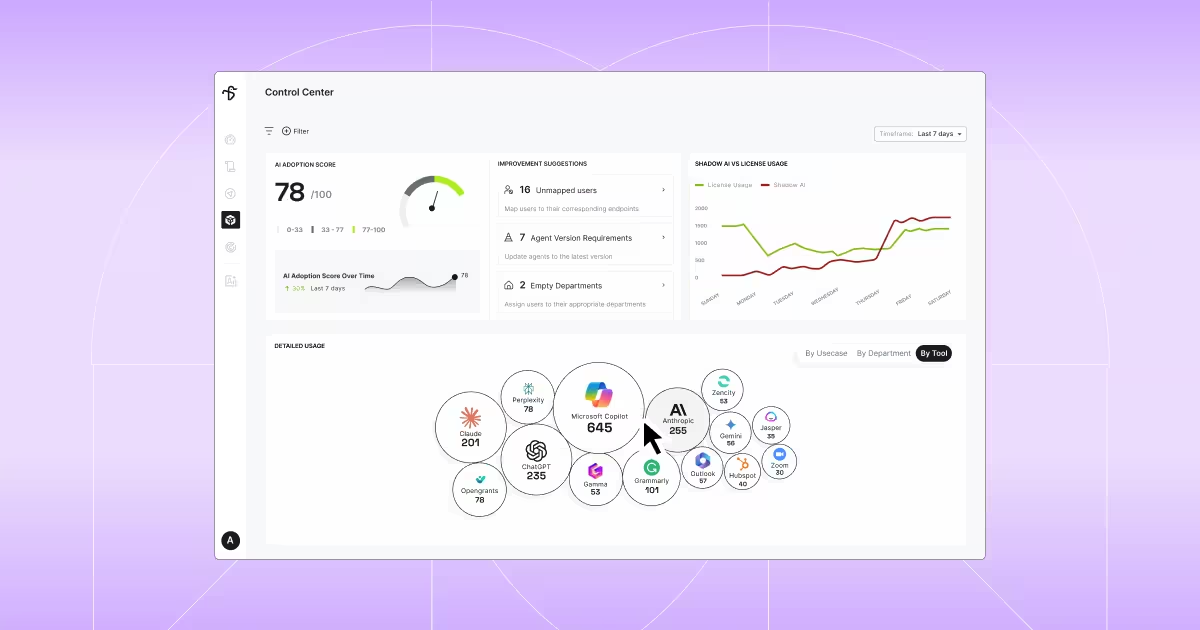
Vanderhorst manages the city's website on his own, alongside the rest of his job. When the city began scanning its roughly 1,250 pages with Refresh, Citibot's website tool for content health, ADA compliance and PDF remediation, in March, it found about 4,800 issues. Most were about voice (plain language and tone), followed by freshness (outdated information) and accuracy (details that contradict each other).
"The task seemed insurmountable," he says.
What he did.
Vanderhorst kept it simple: "I reviewed a few pages each day and made corrections as I went."
Deleting did the most good. Many pages had several problems at once, so removing outdated content fixed them all in one step. The municipal pool page was a typical case: it relied on PDF calendars, its fees didn't match other pages, and some details were out of date.
The scan helped him know where to look. "Refresh helped surface them in an organized way that included the 'why' for why it identified something as a problem," he says.
The results.
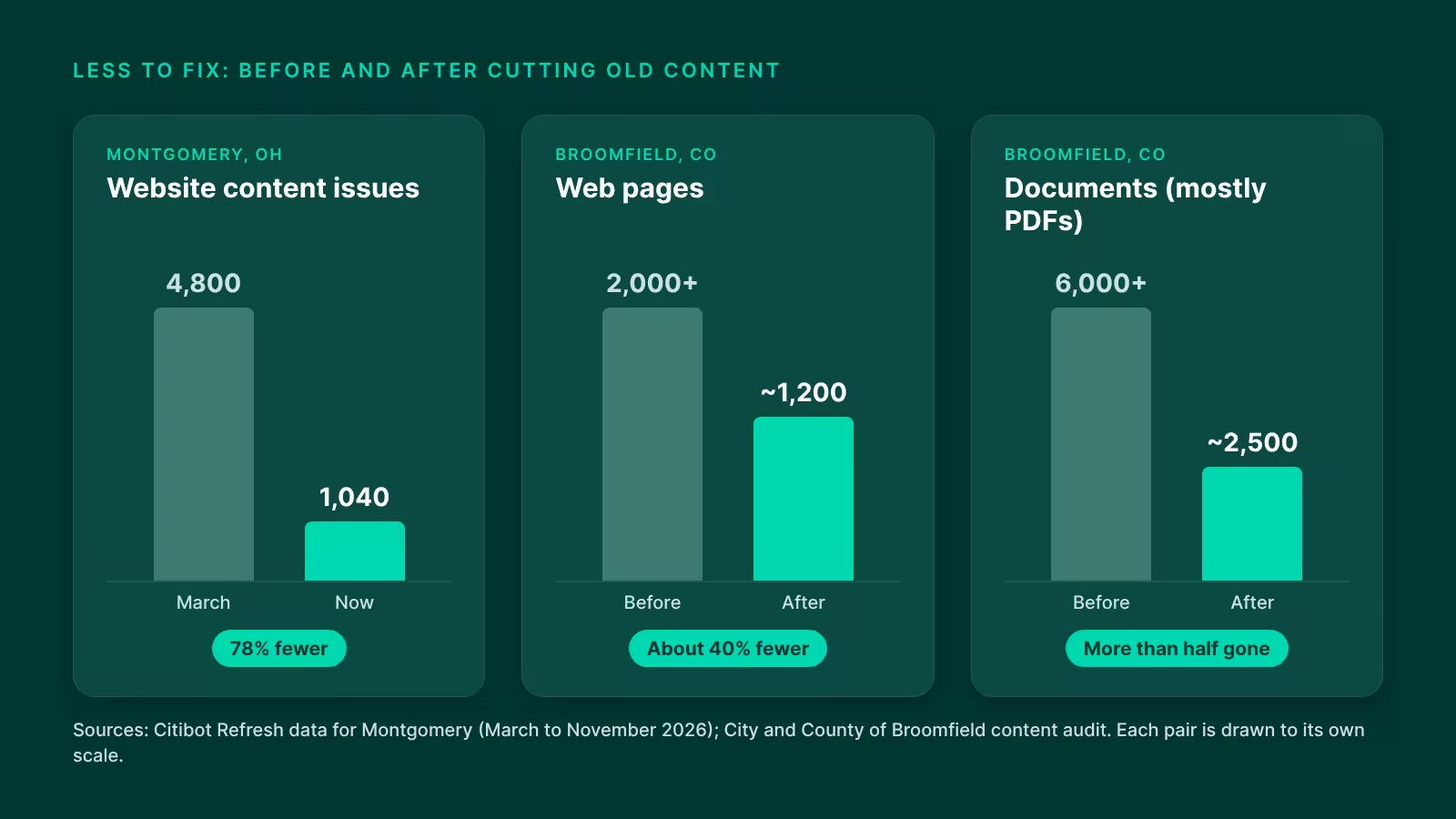
- Open issues went down 78% since March, from about 4,800 to 1,040
- Freshness issues were reduced from about 1,100 to 4
- What's left to fix is mostly plain-language polish, not wrong information
- The chatbot's accuracy is "very good since it's working from good content." Montgomery reviews chat results regularly and updates pages when an answer falls short.
- Accessibility is now part of how the city publishes new content
Broomfield, Colorado: everyone's job
The challenge.
When Colorado passed House Bill 21-1110 in 2021, the City and County of Broomfield (CCOB) already cared about accessibility. The law gave the work a deadline and a structure.
"State laws really allowed us to put more priority and structure around the efforts that we were already taking," says Julie Story, Director of Communications and Engagement.
The scale was daunting. CCOB had worked with the same website vendor since 2010 or earlier, and content had piled up. "The sheer volume, I think, is very overwhelming," Albl says.
What CCOB did.
- Made it an organization-wide project. The CCOBDigital Accessibility Project brought together IT, Communications and Engagement, the Development, Diversity, Equity and Inclusion team, and Legal and Risk Management. Every department now has at least one accessibility rep. "You don't just have one team that says, oh, okay, we're going to make everything accessible," Story says. "We look at it as everybody's responsibility."
- Audited before fixing. The team first sorted out what was still relevant and in use. "We didn't want to necessarily look at everything and say, okay, we need to fix every single one of these things," Albl says.
- Fixed documents where they're made. Most of CCOB's PDFs start as Google Docs or Slides, so the city uses a document tool, Grackle, that checks files inside Google Workspace before they're exported.
- Turned common mistakes into training. Since mid-2026, Albl and the C&E team has used Refresh to track accessibility, freshness and accuracy across the site and to spot mistakes that keep recurring across 30+ departments. Those patterns shape quarterly sessions with department web reps, a newsletter and an intranet resource page.
- Showed staff why it matters. At an all-staff Empathy Lab, employees tried screen readers, low-vision and color-blindness glasses, adaptive scissors and more. Rules about headings suddenly made sense once people heard a screen reader jump from section to section. "When they saw that, it was like, oh, okay, now I get what you're talking about," Story says.
The results.
- From 2,000+ pages to about 1,200, and from 6,000+ documents to just under 2,500
- An accessibility rep in every department
- Annual accessibility training for every employee
- Better-structured pages that search engines and AI tools can read, so CCOB shows up as the source of truth
Best practices your peers recommend
- Cut before you fix. Both cities removed outdated content first. Every page you delete is one you never have to remediate.
- Start with what residents actually do. "No one's going to the website to read the mission statement or see who's on city council," Torrez says. Use your analytics to find top tasks, like paying a utility bill or applying for a permit, and test each one from start to finish with assistive technology.
- Write for everyone. Cognitive disability is the most common type among U.S. adults, Torrez notes. "You have to write at a reading level such that everyone can understand it."
- Fix documents where they're created. "If we could teach people how to make things accessible when they create something for the first time, it would go a long way," Torrez says. CCOB checks documents before they're exported.
- Turn fixes into training. Track the mistakes you see most and train others around these, as CCOB does each quarter.
- Show staff the why. A hands-on session like CCOB's Empathy Lab builds buy-in that a policy memo can't.

You can never install an AI tool and then say that you’re done with accessibility.
Don Torrez
Independent ADA consultant
- Use automated tools, and keep a person in the loop. Today's tools can find and fix much of the work, Torrez says. "You will always need a human being at the end of your testing to make sure it works." If you add a resident chatbot, keep it limited to your own website.
Back to those questions
"Where do we even start?" With the pages residents use most, a few at a time. That's how Montgomery got through about 4,800 issues with one person.
"We don't have the staff." Montgomery shows how far one person can get by working steadily. CCOB shows the other path: share the work across departments. Pennsylvania's chief accessibility officer, Kristopher Adams, made the same point to Route Fifty: "Accessibility must be distributed into the existing roles that are out there."
"Can we wait and see?" DOJ says it expects to enforce the rule at the new deadlines. Both cities treat accessibility as part of everyday publishing rather than a one-time project, so there's nothing to wait for.
"Do we just delete everything?" Delete what's outdated, not what residents need. Both cities cut stale and duplicate content first, which shrank the job without taking services offline. Before removing public records or archived documents, check with your attorney: the rule has limited exceptions for archived content.
Questions to ask before you buy
If you’re a government employee looking for tools to help ai you in this work, Torrez suggests asking every vendor these questions:
His bottom line: "Make sure that people can access programs and services."
Getting the tools you need before the deadline
You can buy this help through cooperative contracts on Civic Marketplace that have already been competitively solicited. For accessibility audits, remediation and training, the ADA Web Accessibility Consulting contract includes suppliers such as Nelnet Government Services, Word Wizards and Connectivo. Refresh by Citibot, which both cities use, is on the Artificial Intelligence Solutions for Public Sector Entities and AI Data Innovation Solutions for Smarter Communities contracts. You can compare options and request quotes from several suppliers at once, or email [email protected]. It's free for state and local government and schools.¹
Have an accessibility story to share with your peers? Contact [email protected].
¹ Suppliers pay a nominal fee set by their lead entity's master services agreement.
Sources
- Federal Register: Extension of compliance dates (Apr. 20, 2026)
- NLC responds to DOJ's extension (Apr. 17, 2026)
- Route Fifty: Amid rule delay, website accessibility must be "ongoing practice," leaders say
- SBA Office of Advocacy: Small towns and communities on DOJ's ADA rule
- Minot Daily News: Officials say federal accessibility rule could erase government website content
Refresh de Citibot, que utilizan ambas ciudades, ofrece un plan de 90 días para sitios web hasta fin de año.

Citibot's Cooperative Contracts
Artificial Intelligence Solutions for Public Sector Entities
Go to contract | Request a quote
Cooperative contract: AI Data Innovation Solutions for Smarter Communities
Go to contract | Request a quote