What Civic Marketplace’s model policy says to keep on file to defend a cooperative purchase in a compliance review
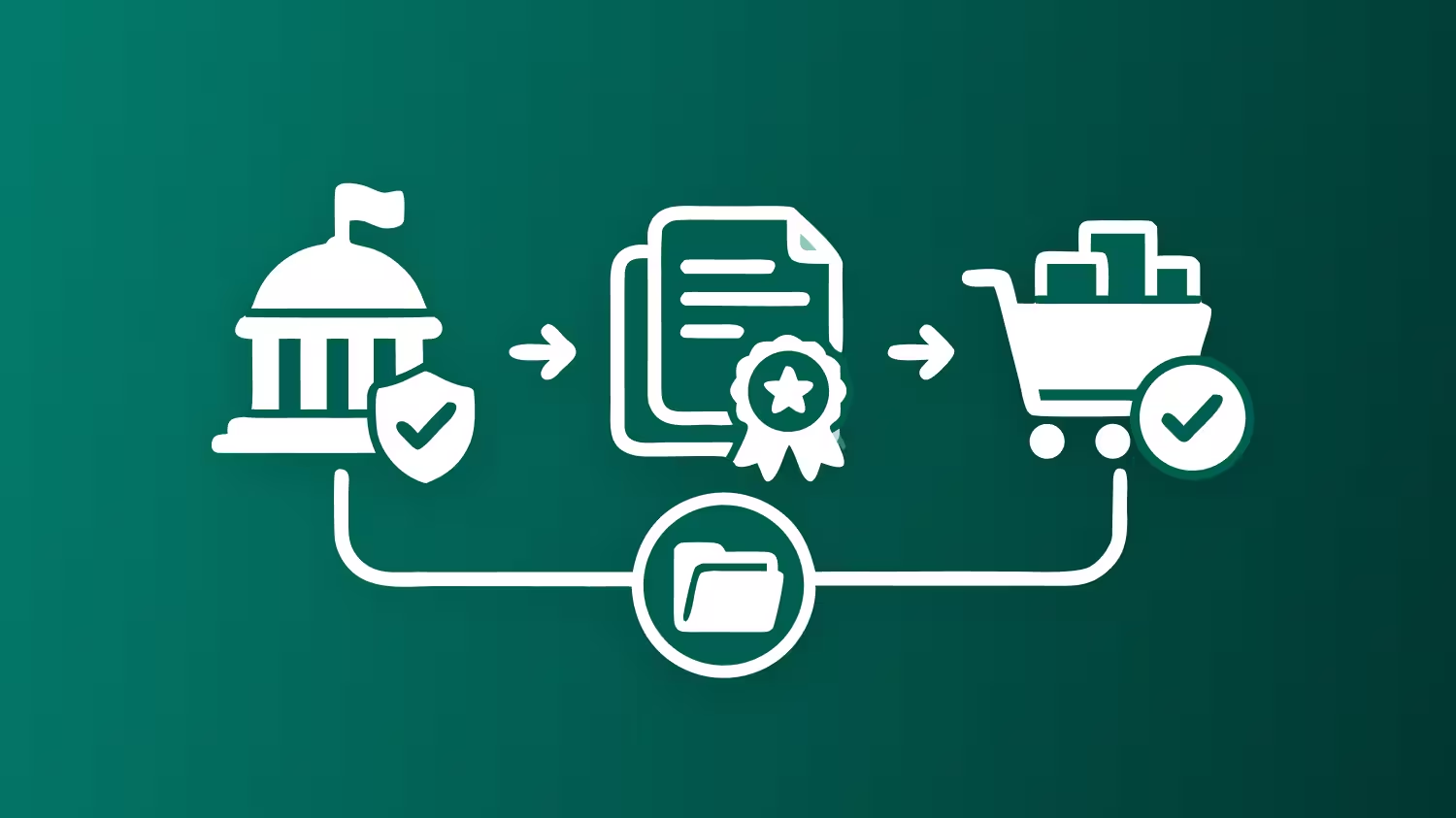
Table of contents
To defend a cooperative contract purchase, your file must show three things: your Entity had authority to use the contract, the lead agency competed and awarded it properly, and this purchase fits the contract and was approved. The Civic Marketplace model policy for the use of cooperatives lists the core documents: a copy of the cooperative contract, the lead agency's solicitation documentation (bid tabulations, award documentation, and proof of advertisement), and a justification memo. A contract the lead agency awarded competitively still needs your own due diligence and written approval before you order.
Authority to use the contract
Without legal and statutory authority, the rest of your file cannot carry the purchase. Our model policy's Legal and Statutory Authority section points to where that authority comes from: your state's interlocal cooperation law and your local charter and ordinances. Authority is not self-evident from the contract itself. Even when the contract names your Entity as an eligible participant, your file still needs to show that your Entity, specifically, had the legal and procedural authority to act on it on the date you did.
Your Entity's authority to use a cooperative contract typically rests on three layers.
State law
Your state's interlocal cooperation statute sets out when local governments may contract with one another or with a cooperative purchasing organization. Confirm that it covers the type of cooperative arrangement you are using and keep a copy in the file.
Local charter and ordinances
Even where state law permits cooperative purchasing broadly, your Entity's own rules may set additional conditions, and state or local rules can bar some commodities and services from cooperative purchase altogether. Read those provisions before you place an order and note in your file which provisions apply.
Council or Board thresholds
Under our model policy, participation in intergovernmental purchasing agreements is subject to Council or Board approval thresholds. Identify your threshold, confirm whether this purchase meets or exceeds it, and document the outcome. If Council or Board approval is required, that approval record belongs in the file.
Interlocal agreements
Alongside those three layers, if your Entity signed an interlocal agreement to use the contract, keep a copy in the file. Our model policy also lists other public Entities as a source of cooperative agreements: those eligible under state statutes, or those that have a cooperative interlocal agreement with your Entity.
The lead agency's record
A cooperative contract is only as defensible as the competition behind it. Our model policy requires staff to verify that the lead agency conducted a competitive solicitation before you piggyback on its award. The documents to keep cover four areas.
Competitive solicitation
Keep evidence that the lead agency used a competitive process (an Invitation for Bids or a Request for Proposals) and evaluated responses against published criteria.
Proof of advertisement
Keep proof that the lead agency advertised the solicitation so that qualified Suppliers had a fair opportunity to respond. A copy of the public notice or a link to the official posting serves this purpose.
Bid tabulations
The bid tabulations show which Suppliers responded and what prices they offered. This record is what lets a reviewer trace the price you are paying back to a field of competing offers.
Award documentation
The award documentation is the formal record showing which Supplier was selected, on what basis, and under what authority. Our model policy has the requester provide these documents for approval, so gather all four before you request approval and build that step into your cooperative purchasing workflow.
The contract itself
Keep a copy of the cooperative contract itself in your procurement file. From that copy, confirm three things before you order: the term, your eligibility and the scope.
Term and eligibility
Verify that the contract is active on the date of your purchase, not expired or terminated. A contract that was valid when the lead agency awarded it may have since lapsed. Then check your Entity's eligibility: confirm that the contract names your Entity as an eligible participant.
Scope and add-ons
The purchase must fall within the original scope of the cooperative contract. Our model policy treats anything outside that scope as an add-on: it needs separate competition unless the lead agency's solicitation and contract documents specifically allow it. A contract for office supplies does not cover furniture simply because the same Supplier carries it. A contract for IT hardware does not extend to professional services unless the original solicitation included them.
Split purchases
The model policy is also direct on split purchases: do not divide a purchase into smaller orders to stay under approval thresholds. Sequential purchase orders to the same Supplier under the same contract, each just below a threshold, invite scrutiny in a review.
The due diligence checklist
Our model policy requires the requesting department to complete a due diligence checklist and file it in the procurement record before issuing a purchase order. Beyond the solicitation and contract checks above, the checklist covers five more areas.
Price reasonableness
A price that appears on the cooperative contract is not automatically a reasonable price for your purchase. Even though the contract was competitively awarded, your specific order may involve quantities, configurations, or line items that were not directly competed. Document how you confirmed that the price you are paying reflects fair market value. The model policy's check compares cooperative pricing with recent in-house bids, relevant state term contracts, or market indices. The finding goes in the file.
Supplier performance
Review any available scorecards, references, or dispute history, contact the lead agency if needed, and note the outcome. A cooperative contract tells you the Supplier was qualified at the time of award. It does not tell you how they have performed since.
Socio-economic goals
The model policy's check asks whether local, minority-, woman-, veteran-, small-business, or historically underutilized business (HUB) subcontracting quotes are required. Record the answer in the checklist. The memo carries the summary.
Legal review
The model policy's check confirms that the contract's indemnity, insurance, and governing-law clauses comply with your local requirements, with special conditions attached if needed. Record that review.
Funding verification
Obtain budget unit confirmation that funds are available. If federal funds are involved, document that separately and apply the federal grant requirements as well.
The justification memo
The justification memo is where your file stops being a collection of documents and becomes a coherent record. Our model policy sets out what the memo should include.
Need and value
Start with the procurement need and the estimated value of the purchase. Be specific enough that a reviewer unfamiliar with your operations can understand what problem you were solving and why you needed to solve it at this scale.
Contracts evaluated
Identify the cooperative contract or contracts you evaluated. If you reviewed multiple contracts before selecting one, name them all and note what distinguished the selected contract. This shows that your choice was deliberate rather than automatic.
Best value
Explain why the selected contract offers best value. Best value is not always the lowest price. Document the factors you weighed: pricing relative to market rates, Supplier qualifications, delivery terms, service levels, and any other criteria relevant to your Entity's needs.
Socio-economic impacts
Our model policy says the memo should include socio-economic impacts. Note whether the purchase supports local businesses, historically underutilized businesses, or diverse Suppliers, and describe any mitigation steps if it does not.
Due diligence completed
Record the due diligence you completed. This links the memo to the due diligence checklist. The memo does not need to reproduce every finding, but it should confirm that each step was done.
The request
Close with the request: authorization to piggyback on the named contract number and lead agency. State both clearly. The approval that follows this request is the document that authorizes your purchase.
Federal funds
Federal funding adds a distinct layer of documentation requirements. Our model policy states that when federal funds are used, sections 200.318 through 200.326 of Title 2 of the Code of Federal Regulations (2 CFR) apply, and that users must incorporate any additional clauses mandated by 2 CFR 200 when federal funds are involved. Three provisions bear directly on a cooperative purchase.
Strategic sourcing: 200.318(e)
Paragraph (e) of 2 CFR 200.318 covers "State and local intergovernmental agreements or inter-entity agreements" and similar arrangements for common or shared goods and services. It says: "Documented procurement actions of this type (using strategic sourcing, shared services, and other similar procurement arrangements) will meet the competition requirements of this part." The operative word is "documented." For a cooperative purchase, your file is what shows that documentation exists.
Records: 200.318(i)
Under 2 CFR 200.318(i), your Entity "must maintain records sufficient to detail the history of each procurement transaction. These records must include the rationale for the procurement method, contract type selection, contractor selection or rejection, and the basis for the contract price." Most of that list is already in your justification memo and due diligence checklist. Add a line on the contract type.
Retention: 200.334
On retention, 2 CFR 200.334 says your Entity "must retain all Federal award records for three years from the date of submission of their final financial report." That clock starts when you submit the final financial report, not when you make the purchase. For awards renewed quarterly or annually, it runs from the quarterly or annual financial report. Records for property and equipment acquired with the support of Federal funds must be retained for three years after final disposition. And the retention period can extend further: if any litigation, claim, or audit starts before the three-year period ends, you retain the records until it is resolved and final action taken.
Exclusion checks
Two more provisions deserve attention. Under section 200.318(h), your Entity "must award contracts only to responsible contractors that possess the ability to perform successfully under the terms and conditions of a proposed contract." Section 200.214, on suspension and debarment, points to regulations that "restrict making Federal awards, subawards, and contracts with certain parties that are debarred, suspended, or otherwise excluded from receiving or participating in Federal awards." Before you order with federal funds, check that the Supplier is not excluded, and document that check.
Across all of these federal rules, your Entity makes the compliance determination. No cooperative program or platform makes a federally funded purchase compliant on your behalf.
After the order
The file does not close when the purchase order is issued.
Approval and tracking
Our model policy is explicit: all requests to use a cooperative contract are reviewed and approved in writing before any purchase or contract execution. That approval record is your starting point. From there, the purchase must be encumbered and tracked in your financial system for audit and reporting purposes. An order that is in your procurement file but not in your financial records leaves a gap.
Delivery and invoices
Keep the delivery and acceptance records, the itemized invoices, and a note of each invoice review with the file. Check the unit prices on each invoice against the contract pricing, and record any difference. Under our model policy, departments monitor contract performance and tell Purchasing about any issues or changes in scope, pricing, or Supplier. Where federal funds are used, the federal procurement standards also require you to "maintain oversight to ensure that contractors perform in accordance with the terms, conditions, and specifications of their contracts or purchase orders."
Records retention
Keep all cooperative contract documentation, approval records, and supporting materials, including delivery and invoice records, under your Entity's records retention policy. Apply that policy alongside the federal retention clock where both apply.
Where Civic Marketplace fits
We understand that building a defensible cooperative file under pressure is hard. The documentation requirements are real, and your team is managing this alongside every other procurement on the calendar.
Civic Marketplace supports that process. The platform gives your team a clear view of every step, quote, and decision in one place, documentation included. When you select your Supplier, you can download contract files and share them. There is no cost for Entities to access cooperative contracts through the platform.
Our case study on Kerr County and the Upper Guadalupe River Authority shows a cooperative purchase made in record time. After a regional emergency, the Upper Guadalupe River Authority in Kerr County, Texas, bought flood warning sirens through a TXShare cooperative contract procured under 2 CFR 200 and available through Civic Marketplace, so the purchase could move at pace. "There can be a lot of temptation to cut corners in procurement compliance," said William Whitson, Long Term Recovery Senior Consultant at Kerr Together. "But if you're spending public money, you've got to get the procurement right. You have to cross your t’s, dot your i’s, and make sure everything is transparent."
Civic Marketplace is here to help you keep the documentation in one place for when a reviewer asks. Book a demo to see how Civic Marketplace supports your cooperative compliance file.

- Civic Marketplace. "Model Policy for Use of Cooperatives." https://www.civicmarketplace.com/help-center/articles/model-policy-for-use-of-cooperatives
- Civic Marketplace. "How Kerr County and the Upper Guadalupe River Authority Responded to Tragedy in Record Time." August 25, 2026. https://www.civicmarketplace.com/news/how-kerr-county-and-the-upper-guadalupe-river-authority-responded-to-tragedy-in-record-time
- Electronic Code of Federal Regulations (eCFR). "2 CFR 200.318: General procurement standards." https://www.ecfr.gov/current/title-2/subtitle-A/chapter-II/part-200/subpart-D/subject-group-ECFR45ddd4419ad436d/section-200.318
- Electronic Code of Federal Regulations (eCFR). "2 CFR 200.334: Record retention requirements." https://www.ecfr.gov/current/title-2/subtitle-A/chapter-II/part-200/subpart-D/subject-group-ECFR4acc10e7e3b676f/section-200.334
- Electronic Code of Federal Regulations (eCFR). "2 CFR 200.214: Suspension and debarment." https://www.ecfr.gov/current/title-2/part-200/section-200.214