Cooperative Agreement Compliance With Local Procurement Regulations

Cooperative agreements stay compliant when the lead solicitation and the local agency’s actual purchase both align with applicable statutes, internal policy, approval workflows, and documentation standards. As of March 2026, compliance depends less on the cooperative label itself and more on whether the agency can prove legal authority, scope fit, price defensibility, and local approval.
That distinction matters in practice. A cooperative contract can be valid at the source and still be misapplied locally. Public agencies need a framework that preserves procurement speed without weakening auditability, transparency, or board oversight. This article sets out that framework in operational terms.
What Compliance Means in Cooperative Purchasing
Cooperative purchasing means two or more public agencies purchase under the same competitively awarded contract. The NASPO cooperative purchasing guide defines it as governments sharing procurement contracts, and notes that cooperative purchasing should occur through contracts awarded through full and open competition or substantially equivalent methods (NASPO guide, 2020).
At the center of that structure is the lead agency, the public entity that issues the solicitation, evaluates responses, and makes the award. GovMVMT (2026) describes the lead agency model as the gold standard because the award is made by a real public agency rather than by a private intermediary, which improves transparency and accountability (GovMVMT compliance framework).
Piggybacking is the local agency’s act of purchasing from that existing contract. That is where many compliance mistakes occur. A cooperative vehicle may be available, but local utilization still must satisfy charter provisions, code thresholds, local preference rules, insurance requirements, and governing body approvals.
Civic Marketplace’s model policy makes this point directly: staff must verify that the lead agency conducted a competitive solicitation compliant with applicable procurement laws, and departments must confirm the agreement fits local requirements for scope, pricing, term, and compliance obligations (Civic Marketplace model policy, updated September 2025).
A valid cooperative contract is not the same as a compliant local purchase. The first concerns how the master contract was awarded. The second concerns whether the local agency had legal authority to rely on it, obtained the right approvals, and retained a defensible file.
Five Checks Before Using a Cooperative Agreement
Public agencies can reduce most cooperative compliance risk by completing five checks before issuing a purchase order or executing a participating agreement.
1. Confirm Statutory Authority
Start with state law, local ordinance, charter language, and procurement manual provisions. Civic Marketplace’s model policy points agencies to specific legal authority, including interlocal cooperation statutes and local approval thresholds, and expressly flags added federal requirements when grant funds are involved (Civic Marketplace policy language, 2025).
This check matters for municipalities, school districts, and special districts alike. A city may have broad interlocal authority but still require council approval above a dollar threshold. A school district may have purchasing authority but face separate board agenda timing or delegated-signature limits.
2. Verify Competitive Solicitation Equivalency
The agency should obtain the lead solicitation record and determine whether the procurement process is substantially equivalent to local competitive requirements. The NASPO guide states that cooperative purchasing should occur through contracts awarded through full and open competition, while 40 CFR Part 35 Subpart O requires publicized requests for proposals, disclosed evaluation factors, solicitation from an adequate number of qualified sources, technical evaluation methods, and award to the responsible firm whose proposal is most advantageous when federal rules apply (NASPO, 2020; EPA eCFR, current as of March 2026).
That does not mean duplicating the original solicitation. It means confirming the original process can withstand local scrutiny.
3. Test Scope Fit
The local purchase must fall within the awarded scope, term, pricing structure, and geographic eligibility of the cooperative contract. Scope mismatch is one of the fastest ways to turn a compliant vehicle into a noncompliant transaction. If the contract covers software licensing, implementation, and support, adding unrelated consulting work may require separate procurement.
4. Check Local Preference and Policy Alignment
Local rules often survive cooperative utilization. Civic Marketplace’s policy specifically requires review of local preference policies where applicable, along with insurance, indemnification, and contract-term requirements (Civic Marketplace due diligence requirements). This is the point many agencies miss: cooperative purchasing does not automatically preempt local supplier preference, MWBE programs, or negotiation protocols.
5. Complete Internal Approvals and Documentation
Civic Marketplace’s model policy requires all requests to utilize a cooperative contract to be submitted for procurement review and approval before purchase or execution, with supporting materials such as the contract, solicitation record, and a justification memo (Civic Marketplace approval workflow). That structure preserves speed because staff are not recreating a solicitation, but they are preserving a decision trail.
As of March 2026, this five-check sequence remains the most defensible operating model because it addresses the legal question, the procedural question, and the audit question in one workflow.
Cooperative vs. Traditional Procurement Checks
The compliance logic overlaps with traditional procurement, but the evidence file differs.
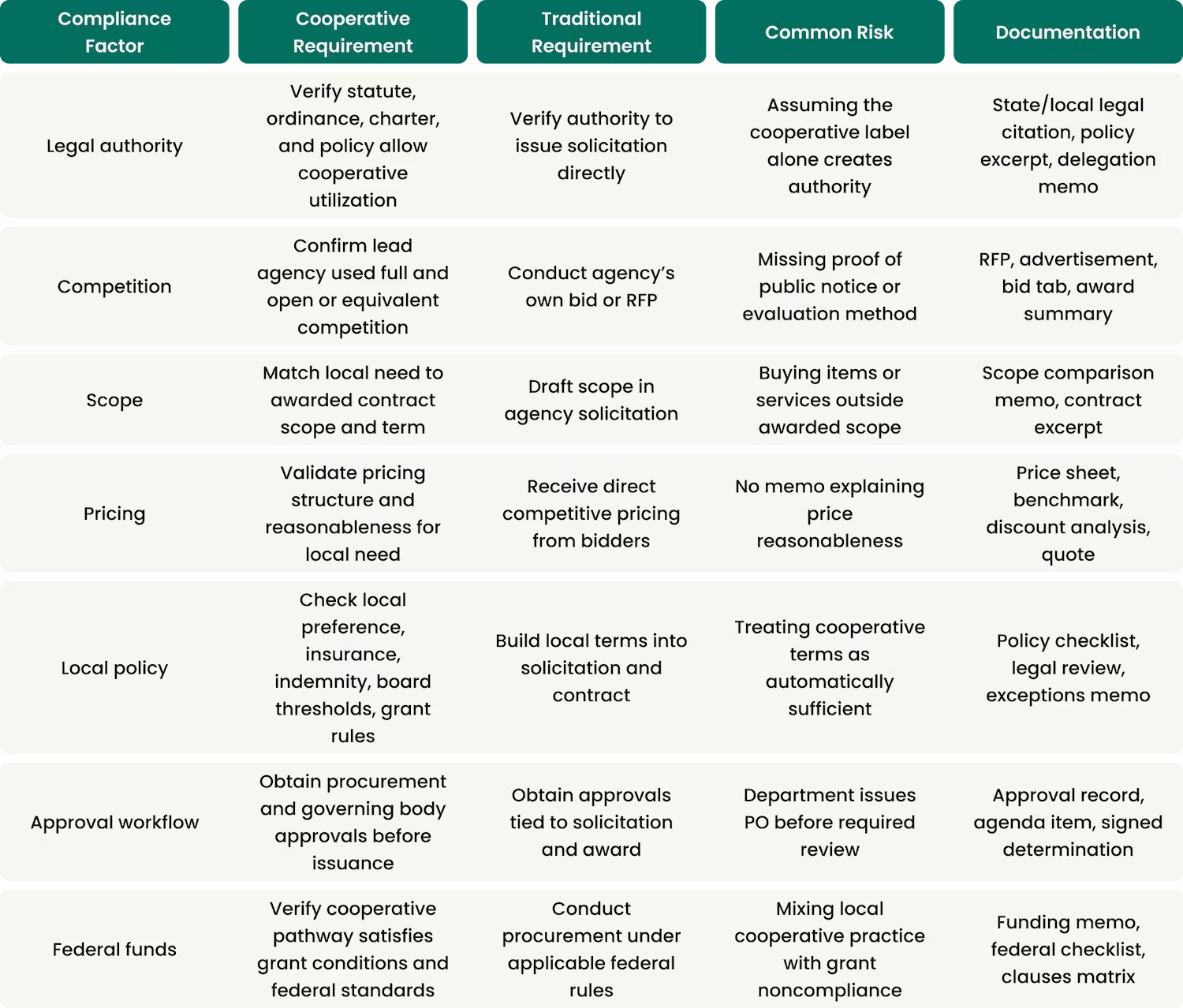
Cooperative purchasing does not eliminate compliance work. It relocates the work from solicitation execution to due diligence, authority review, and documentation architecture.
Where Agencies Run Into Compliance Problems
The most common failures are not dramatic. They are procedural shortcuts that accumulate into audit findings.
Scope Drift
Agencies identify a cooperative contract for a general category, then purchase adjacent services that were never evaluated or awarded. OMNIA Partners explains that the lead agency model involves a rigorous solicitation process designed to ensure broad supplier access, competitive evaluation, and strong contract outcomes, which only protects the agency when the local purchase remains inside that evaluated scope (OMNIA Partners, 2026).
Skipped Local Approval
Civic Marketplace’s policy requires cooperative requests to go through the procurement department before any purchase or contract execution. That sequence matters because many local rules attach approval requirements to dollar value, funding source, or contract type, not to whether the contract originated elsewhere (Civic Marketplace, 2025).
Weak Price Documentation
Auditors often ask a simple question: if the agency did not run its own competition, how did it determine that pricing remained reasonable for this purchase? A cooperative contract may provide pre-negotiated pricing, but the local file should still include current price validation, category benchmarks, or a savings rationale.
Federal Funding Gaps
EPA procurement rules in 40 CFR Part 35 require publicized requests, identified evaluation factors, solicitation from an adequate number of qualified sources, technical evaluation methods, and documented selection procedures for covered procurements (EPA eCFR, March 2026). Agencies that handle state-funded and federally funded purchases through the same cooperative workflow without a funding-specific check often create preventable exposure.
This is where Civic Marketplace adds value without displacing agency control. The platform can reduce complexity by centralizing contract records, approval pathways, and supplier information, but the agency still owns the legal determination, policy fit, and final award decision.
Documentation Framework for Auditability
An audit-ready cooperative file should answer five questions quickly: why the agency had authority, how the lead contract was awarded, why the purchase fits the contract, how pricing was validated, and who approved it.
A practical file architecture includes the following components:
- Legal authority citation identifying the state statute, local code section, policy provision, and approval threshold.
- Cooperative contract record including the master agreement, amendments, renewals, and participating addendum if applicable.
- Lead solicitation package with the original RFP or bid, proof of advertisement, evaluation summary, bid tabulation, and award recommendation.
- Scope matching memo explaining how the local goods or services fit the awarded scope, period, and contract terms.
- Pricing validation such as catalog pricing, discount schedule, benchmark quotes, prior-year comparison, or savings memo.
- Approval record including procurement review, legal review if required, budget certification, and board or council action when applicable.
- Supplier due diligence covering suspension checks, insurance, licensing, and grant-specific representations if federal funds are involved.
This structure tracks closely with Civic Marketplace’s policy, which calls for a copy of the cooperative contract, lead agency solicitation documentation, and a justification memo explaining best value, schedule savings, or price savings (Civic Marketplace appendix and approval process).
The operational benefit is measurable. In Civic Marketplace’s July 2025 Dallas case study, the City of Dallas Public Works Department reduced average contractor payment processing time from 30 days to 10 days—a 67% efficiency gain—and cut staff effort from 720 hours to 240 hours after moving to a cooperative-enabled solution with clearer records and workflows (Civic Marketplace case study, 2025).
A final discipline helps preserve freshness. Agencies should review cooperative files annually for active use contracts. Civic Marketplace’s model policy requires policy updates as laws and guidance change, which is a practical reminder that a compliant cooperative file in 2025 may need a revised legal or funding check in 2026 (Civic Marketplace training and compliance section, 2025).
References
- Civic Marketplace. "Model Policy for Use of Cooperatives." https://www.civicmarketplace.com/help-center/articles/model-policy-for-use-of-cooperatives (2025).
- Civic Marketplace. "Streamlining Project Tracking at the City of Dallas Public Works Department." https://www.civicmarketplace.com/news/streamlining-project-tracking-city-dallas-public-works-department-through-txshare-cooperative-contract (2025).
- GovMVMT. "Cooperative Contracts and Compliance." https://www.govmvmt.org/cooperative-contracts-compliance/ (2026).
- Electronic Code of Federal Regulations. "40 CFR Part 35 Subpart O." https://www.ecfr.gov/current/title-40/chapter-I/subchapter-B/part-35/subpart-O (2026).
- NASPO ValuePoint. "An Introduction to Cooperative Purchasing." https://naspovaluepoint.org/wp-content/uploads/2020/08/Cooperative_Purchasing0410update.pdf (2020).
- OMNIA Partners. "Cooperative Purchasing 101." https://www.omniapartners.com/cooperative-purchasing-101 (2026).
- Roadmap Consulting. "GSA Cooperative Purchasing: A Guide for State & Local Governments." https://www.roadmapc.com/gsa-contract/cooperative-purchasing/ (2026).





.avif)

.avif)