Table of contents
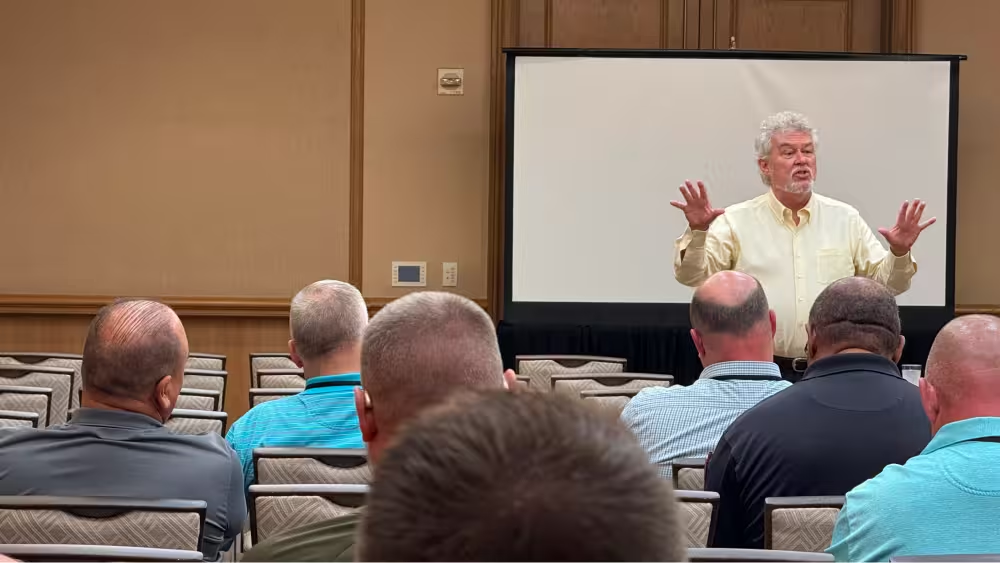
I was deeply inspired by the engagement, thought leadership, and practical insights shared during NIGP VCON's session, The Next Era of Public Procurement: Leveraging Data to Strengthen Compliance, Competition, and Community Impact. This blog is an effort to continue that conversation and highlight the opportunities ahead for our profession.
Early in our NIGP VCon session on data and procurement, Marcheta Gillespie, Executive Director of NIGP Consulting, asked the panelists a simple question: What's particularly challenging for your entity today when it comes to accessing and analyzing the data you wish you could get to?
The responses came in quickly. Fragmented data. Too many platforms. Everything is manual. There's no database for procurement. Just getting access, period.
These weren’t the responses of under-resourced, one-person shops; they were experienced practitioners at agencies across the country. People with certifications, strategy experience, and years of navigating complex organizational environments.
So let’s set aside the idea that this is a skills problem. It isn’t. What people are describing is structural. And the case studies we heard from Chris Belasco, Chief Data Officer at the City of Pittsburgh, and Damian Espinoza, Senior Buyer at the City of Brownsville, showed what it looks like to work through it.
For Pittsburgh, safety was the entry point
Chris’ team’s data journey began with worker safety. Specifically, a metric called the DART rate (days away, restricted, and transferred), which tracks serious workplace injuries per 100 employees. Governments aren’t required to report this to the Occupational Safety and Health Administration (OSHA), but Pittsburgh chose to start measuring it anyway.
The reason they picked safety as the entry point was straightforward, explained Chris. “You and I may see how we do our work differently. We may see prioritization differently … But you and I are actually ultimately going to agree that the thing that takes priority over anything else is safety, right? Everybody wants to make sure that they and their coworkers all come home the way that they showed up that day.”
That shared value created the psychological safety to get honest data in the room. The team build the reporting in stages – paper forms first, then Microsoft Forms, then Power Automate piped into Google Cloud and Looker Studio. Within the Department of Public Works, they saw a 50% reduction in safety incidents.
Then something interesting happened. The habit of asking why – tracing problems to their root cause rather than patching the symptom – started carrying over into other parts of city operations. When their team kept hitting data quality problems that were breaking dashboards, they asked why the data was unreliable in the first place and traced it to a gap in their data governance. Solving that gap meant defining the problem precisely and going to procurement to find a solution – which is exactly what they did, writing an RFP scoped around the specific issue they’d uncovered. .
Those questions eventually led them to write an RFP, Chris explained. “We worked with procurement to take the problem that we had encountered, build language into our RFP that defined the problem that we were trying to solve, and then build that into the scope of work for the solution that we wanted to procure.”
The data governance and procurement function ended up telling the same story.
Brownsville started with a vendor pain point
Damian Espinoza’s team in Brownsville kept hearing the same thing from local businesses: doing business with the city was hard, intimidating, and not worth the effort.
“Once you have that one-on-one conversation with them, they start to notice and figure out, like, oh wait, this isn't so bad. This is not as scary as it's made out to be.”
That observation became the seed of their First Quote program. Rather than wait for a technology solution to appear, Damian’s team asked: what problem are we actually solving? The answer was two things: slow procurement cycles and low local vendor engagement.
The program they built addresses both. Suppliers enroll, upload certifications and credentials, and departments can request quotes directly from a vetted local pool. Procurement gets faster. Local business participation is tracked and can be grown with intention.
Brownsville’s city priorities explicitly included keeping local businesses connected to the city’s growth. That gave the procurement team something real to work backwards from. As Damian put it: “We want to make sure that we invite vendors to be part of that growth.”
What the stories have in common
Neither Chris nor Damian started by building a data infrastructure. Both identified a problem that mattered to people, built trust with those audiences, and then let the data work follow.
Marcheta frames it like this: look at your entity’s strategic plan, and if you don’t have a procurement-specific plan, look at your organization’s broader one. “That should be telling as to what data is important.”
Most procurement teams start by asking what they can measure. Both the Pittsburgh and Brownsville teams flipped that. Figure out what you’re trying to achieve first – for your community, your leadership, your suppliers – and the data questions follow naturally.
A few things worth taking back to your desk:
Define your purpose before your metrics. What does procurement exist to deliver for your community? What change do you want to see? Let KPIs follow from that.
Create psychological safety around data. If people are think data will be used against them, they’ll protect it. If they think it will be used to solve problems they care about, they'll share it. Pittsburgh made this explicit with safety; Brownsville made it explicit with vendors.
Don't wait for perfect infrastructure. As Chris said, “People have to figure out where to start, and they can’t start anywhere … other than where they are.” A spreadsheet tracking one meaningful metric, tied to something leadership cares about, is a real starting point.
The procurement professionals in this community are the interface between public resources and public outcomes. Data is how that work becomes visible, defensible and improvable. You don’t need perfect infrastructure to start making it count.

Al Hleileh is a visionary entrepreneur, civic innovator, and the Co-Founder & CEO of Civic Marketplace. A two-time founder with a proven track record of scaling mission-driven ventures, Al blends strategic foresight with relentless execution to drive impact at scale.




.avif)

.avif)